Part 2: Multi Channel Validation for a High-Trust Service Business

Under the Longan Tree — How People Validate Trust Across Channels (Part 2)
https://medium.com/media/ef052d2b2528bc68d29b06f46be8c397/href
In Part 1, I covered the market research and who books professional pet care. This is Part 2 and what it meant for the website redesign.
Most of us don’t trust businesses based on one source anymore, especially for services where trust matters. We’re all bombarded with marketing and have built up a resistance to any single source claiming to be the best. We cross-reference. We look for patterns across Google reviews, social proof, websites, and peer recommendations.
I’m in a small guesthouse in the hills in Pai
where chickens roam freely through the garden and their gentle clucking creates the most peaceful soundtrack imaginable that takes me straight back to my Grandpa’s garden in Ukraine.
What makes this guesthouse special isn’t the amenities. It’s how the elderly owners see their guests. They don’t ask what you need, they are not overly smiling or faking interest. But they are present and authentic. When they noticed me working awkwardly with my laptop balanced on my knees under the longan tree, the owner brought a small wooden desk and wished me success with some fresh fruits.
I experience many situations like this here, and this is what being seen as a human being looks like for me. It’s the difference between a pure transaction and being cared for as a person.
Despite providing exceptional service that creates fierce loyalty (this is my third visit), this guesthouse goes quiet during low season.
While exceptional service builds long-term relationships and repeat customers, discoverability determines who you can build relationships with in the first place.
You can’t connect if people can’t find you. And this guesthouse was truly not easy to find.
Sustainable Alignment Over Maximum Bookings
Sitting in that garden, organizing my thoughts, I realized my priorities hadn’t really changed despite two years of traveling. I never wanted to be the busiest pet sitter in Hamburg, I wanted to be the right cat sitter for the right clients. What makes this work long-term isn’t volume; it’s that fit.
My goals were to reconnect with previous clients while attracting new aligned ones, test premium pricing that valued my expertise and create a flexible foundation that is still consistent for the European Petsitting Idea.
When stakes are high, we rarely follow linear paths.
Traditional customer journey maps present discovery as a linear path: awareness → consideration → decision. Clean arrows pointing forward. While UX practitioners understand journeys are non-linear, conversion-focused design often optimizes for predictable sequences, pushing toward a single action, removing friction at every step
This matches what research shows: 74% of people check at least two review platforms when researching local businesses (BrightLocal 2025), and for high-stakes services like pet care, this cross-referencing intensifies. People don’t just check multiple review sites. They validate across completely different channel types: Google reviews, Instagram feeds, website details, friend recommendations before making contact.
For a service like pet sitting, where clients hand over house keys and entrust a family member’s care to a stranger, the website has a job: help people figure out whether we’d work well together and it’s totally okay if the answer is no, while remaining just one piece in a multi-channel ecosystem
Help people understand what they need to know, and make it easy for both aligned and misaligned prospects to figure out if my service is the right fit, while it just remains one piece in a multi-channel ecosystem.
Phase 1: Digital Discovery & Validation
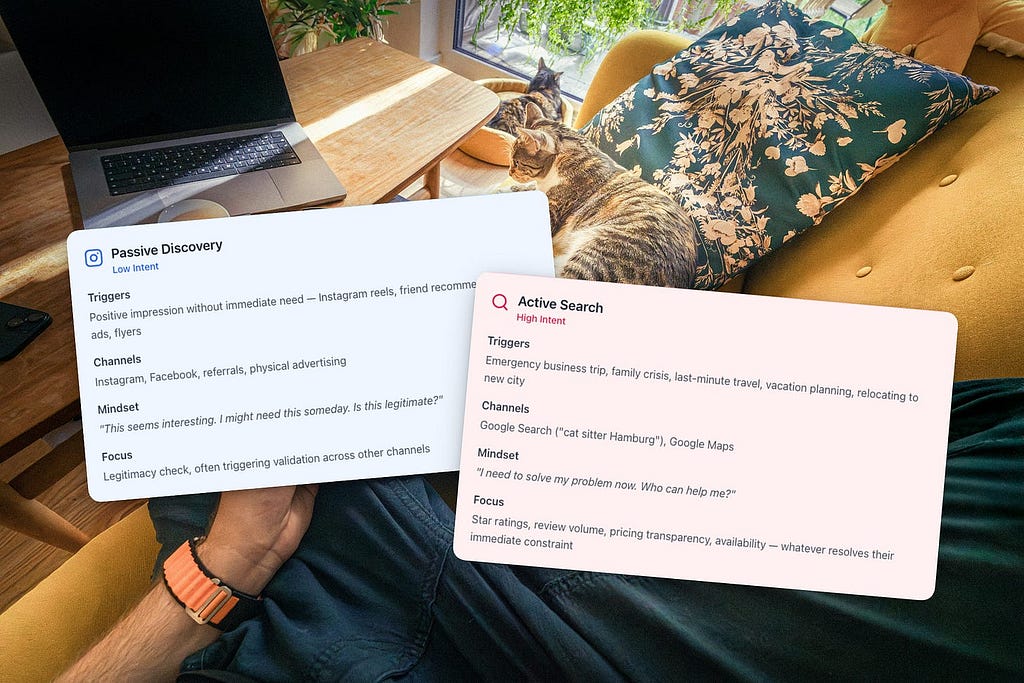
How someone discovers you shapes where they start, but not where they go next. Someone googling at midnight because their flight leaves in 12 hours? They’re checking different things than someone casually browsing Instagram on a Sunday afternoon.
Active Search (High Intent)
- Triggers: Emergency business trip, family crisis, last-minute travel, vacation planning, relocating to new city
- Channels: Google Search (“cat sitter Hamburg”), Google Maps
- Mindset: “I need to solve my problem now. Who can help me?”
- Focus: Star ratings, review volume, pricing transparency, availability — whatever resolves their immediate constraint
Passive Discovery (Low Intent)
- Triggers: Positive impression without immediate need — Instagram reels, friend recommendations, ads, flyers
- Channels: Instagram, Facebook, referrals, physical advertising
- Mindset: “This seems interesting. I might need this someday. Is this legitimate?”
- Focus: Legitimacy check, often triggering validation across other channels
We zigzag across channels unpredictably, driven by whatever specific concern we’re trying to resolve in that moment. Some people check channels multiple times and read every detail on the website, building a complete picture. Others land on a website, check the price, book.
For the new website, I couldn’t optimize for any single type of person because there isn’t a single type of person. There’s the midnight caller, the Instagram stalker, the friend-of-a-friend referral, the person who just moved to Hamburg, the one casually browsing while watching Netflix who doesn’t even have a cat yet but might someday.
What everyone needs is the same thing: enough information to trust their gut feeling about whether we’d be a good match.
Validation paths depend entirely on what they’re trying to resolve:
- Social Media → Google (checking reviews and legitimacy)
- Google → Website (understanding process and personality)
- Website → Instagram (looking for “proof of life” and genuine connection)
- Friend’s Recommendation → still Google you and check website before booking
- Back to Google to re-read reviews after seeing personality on Instagram
The constraints that bring someone to professional pet care directly shape what they validate and when. Someone navigating a Social Framework Gap (new to Hamburg, no network) prioritizes different signals than someone with an Experience-Based Constraint (burned by unreliable sitter). The validation dimensions matter to everyone, but the urgency and order shift based on what constraint they’re trying to resolve.
I put together a free framework for mapping out these constraint patterns. Get it here — it’s free.
The Gap Between Stated and Unstated Concerns
Here’s what I noticed: What people ask about in emails often isn’t the same as what they’re quietly reassuring themselves about.
In my inquiry analysis, 68% of emails implicitly emphasized “loving and reliable care.” But competence? Safety? Trustworthiness? Nobody asked about those directly.
My theory: They’d already confirmed those things before they contacted me. Through website credentials. Through review comments about trustworthiness. Through silently pre-validating during our first meeting while watching how I interact with their cat and how we feel about each other.
By the time they write that first email, the baseline trust is there. The email is asking something deeper: “Will my cat actually enjoy the time with you ?”
The consultation answers that question. Everything else? Already validated invisibly across multiple channels before they hit send.
This gap reveals something important: Much of the validation work likely happens before someone makes contact. The decision emerges naturally when enough pieces click into place, shaped entirely by which constraints brought them to professional care in the first place.
Phase 2: When Complexity Disappears
Once someone becomes a client, the entire dynamic changes. They rarely re-read the website. They don’t check Instagram to make sure I still like cats. They just text: “Are you free June 10–17?”
This is what makes a service business sustainable. Not the first booking, but the second and third and tenth. Getting to that first booking requires the website, the reviews, and the Instagram all working together. After that first positive experience? The complexity disappears.
What This Means for the Design
Creating a coherent presence across touchpoints, so people can check whatever they need to check, in whatever order makes sense to them, until they feel certain. Either certain this feels right, or certain it doesn’t — and honestly, both conclusions save everyone time and energy.
We don’t decide like machines. We decide like people. Messy, emotional, sometimes irrational. Especially when it matters.
For me, good UX respects how people actually decide. Sometimes that means removing barriers. But sometimes it means giving enough depth so someone can evaluate fit.
What’s Coming in Part 3
Part 3 breaks down the actual design decisions: Why certain content is expandable vs. always visible, how structure accommodates different entry points and validation styles, and design choices that help people self-assess fit before making contact.
Want to Follow Along ?
Subscribe for Notifications when Parts 3–4 of this case study drops and on Updates on what I’m building next. I email when I’ve built or learned something worth sharing. No gurus, no schedule, no filler. It’s free.
Let’s Connect
I design and build digital products, moving between product design, frontend code, and UX. Currently traveling the world, building Smarter Goals, and making friends with street dogs in every country I visit.
I’m genuinely open to collaboration and love connecting with people who are building things, learning as they go, staying curious. Whether it’s working together, co-working somewhere in the world, or just talking about what you’re building over coffee, reach out on LinkedIn.
I read everything 💛 ☕
Part 2: Multi Channel Validation for a High-Trust Service Business was originally published in UX Planet on Medium, where people are continuing the conversation by highlighting and responding to this story.
المصدر: المصدر الأصلي
{“@context”:”https://schema.org”,”@type”:”NewsArticle”,”headline”:”Part 2: Multi Channel Validation for a High-Trust Service Business”,”description”:”
Under the Longan Tree — How People Validate Trust Across Channels (Part 2)
https://medium.com/media/ef052d2b2528bc68d29b06f46be8c397/href
In Part 1, I covered the market research and who books professional pet care. This is Part 2 and what it meant for the website redesign.
Most of us don’t trust businesses based on one source anymore, especially for services where trust matters. We’re all bombarded with marketing and have built up a resistance to any single source claiming to be the best. We cross-reference. We look for patterns across Google reviews, social proof, websites, and peer recommendations.
I’m in a small guesthouse in the hills in Pai
where chickens roam freely through the garden and their gentle clucking creates the most peaceful soundtrack imaginable that takes me straight back to my Grandpa’s garden in Ukraine.
What makes this guesthouse special isn’t the amenities. It’s how the elderly owners see their guests. They don’t ask what you need, they are not overly smiling or faking interest. But they are present and authentic. When they noticed me working awkwardly with my laptop balanced on my knees under the longan tree, the owner brought a small wooden desk and wished me success with some fresh fruits.
I experience many situations like this here, and this is what being seen as a human being looks like for me. It’s the difference between a pure transaction and being cared for as a person.
Despite providing exceptional service that creates fierce loyalty (this is my third visit), this guesthouse goes quiet during low season.
While exceptional service builds long-term relationships and repeat customers, discoverability determines who you can build relationships with in the first place.
You can’t connect if people can’t find you. And this guesthouse was truly not easy to find.
Sustainable Alignment Over Maximum Bookings
Sitting in that garden, organizing my thoughts, I realized my priorities hadn’t really changed despite two years of traveling. I never wanted to be the busiest pet sitter in Hamburg, I wanted to be the right cat sitter for the right clients. What makes this work long-term isn’t volume; it’s that fit.
My goals were to reconnect with previous clients while attracting new aligned ones, test premium pricing that valued my expertise and create a flexible foundation that is still consistent for the European Petsitting Idea.
When stakes are high, we rarely follow linear paths.
Traditional customer journey maps present discovery as a linear path: awareness → consideration → decision. Clean arrows pointing forward. While UX practitioners understand journeys are non-linear, conversion-focused design often optimizes for predictable sequences, pushing toward a single action, removing friction at every step
This matches what research shows: 74% of people check at least two review platforms when researching local businesses (BrightLocal 2025), and for high-stakes services like pet care, this cross-referencing intensifies. People don’t just check multiple review sites. They validate across completely different channel types: Google reviews, Instagram feeds, website details, friend recommendations before making contact.
For a service like pet sitting, where clients hand over house keys and entrust a family member’s care to a stranger, the website has a job: help people figure out whether we’d work well together and it’s totally okay if the answer is no, while remaining just one piece in a multi-channel ecosystem
Help people understand what they need to know, and make it easy for both aligned and misaligned prospects to figure out if my service is the right fit, while it just remains one piece in a multi-channel ecosystem.
Phase 1: Digital Discovery & Validation
How someone discovers you shapes where they start, but not where they go next. Someone googling at midnight because their flight leaves in 12 hours? They’re checking different things than someone casually browsing Instagram on a Sunday afternoon.
Active Search (High Intent)
- Triggers: Emergency business trip, family crisis, last-minute travel, vacation planning, relocating to new city
- Channels: Google Search (“cat sitter Hamburg”), Google Maps
- Mindset: “I need to solve my problem now. Who can help me?”
- Focus: Star ratings, review volume, pricing transparency, availability — whatever resolves their immediate constraint
Passive Discovery (Low Intent)
- Triggers: Positive impression without immediate need — Instagram reels, friend recommendations, ads, flyers
- Channels: Instagram, Facebook, referrals, physical advertising
- Mindset: “This seems interesting. I might need this someday. Is this legitimate?”
- Focus: Legitimacy check, often triggering validation across other channels
We zigzag across channels unpredictably, driven by whatever specific concern we’re trying to resolve in that moment. Some people check channels multiple times and read every detail on the website, building a complete picture. Others land on a website, check the price, book.
For the new website, I couldn’t optimize for any single type of person because there isn’t a single type of person. There’s the midnight caller, the Instagram stalker, the friend-of-a-friend referral, the person who just moved to Hamburg, the one casually browsing while watching Netflix who doesn’t even have a cat yet but might someday.
What everyone needs is the same thing: enough information to trust their gut feeling about whether we’d be a good match.
Validation paths depend entirely on what they’re trying to resolve:
- Social Media → Google (checking reviews and legitimacy)
- Google → Website (understanding process and personality)
- Website → Instagram (looking for “proof of life” and genuine connection)
- Friend’s Recommendation → still Google you and check website before booking
- Back to Google to re-read reviews after seeing personality on Instagram
The constraints that bring someone to professional pet care directly shape what they validate and when. Someone navigating a Social Framework Gap (new to Hamburg, no network) prioritizes different signals than someone with an Experience-Based Constraint (burned by unreliable sitter). The validation dimensions matter to everyone, but the urgency and order shift based on what constraint they’re trying to resolve.
I put together a free framework for mapping out these constraint patterns. Get it here — it’s free.
The Gap Between Stated and Unstated Concerns
Here’s what I noticed: What people ask about in emails often isn’t the same as what they’re quietly reassuring themselves about.
In my inquiry analysis, 68% of emails implicitly emphasized “loving and reliable care.” But competence? Safety? Trustworthiness? Nobody asked about those directly.
My theory: They’d already confirmed those things before they contacted me. Through website credentials. Through review comments about trustworthiness. Through silently pre-validating during our first meeting while watching how I interact with their cat and how we feel about each other.
By the time they write that first email, the baseline trust is there. The email is asking something deeper: “Will my cat actually enjoy the time with you ?”
The consultation answers that question. Everything else? Already validated invisibly across multiple channels before they hit send.
This gap reveals something important: Much of the validation work likely happens before someone makes contact. The decision emerges naturally when enough pieces click into place, shaped entirely by which constraints brought them to professional care in the first place.
Phase 2: When Complexity Disappears
Once someone becomes a client, the entire dynamic changes. They rarely re-read the website. They don’t check Instagram to make sure I still like cats. They just text: “Are you free June 10–17?”
This is what makes a service business sustainable. Not the first booking, but the second and third and tenth. Getting to that first booking requires the website, the reviews, and the Instagram all working together. After that first positive experience? The complexity disappears.
What This Means for the Design
Creating a coherent presence across touchpoints, so people can check whatever they need to check, in whatever order makes sense to them, until they feel certain. Either certain this feels right, or certain it doesn’t — and honestly, both conclusions save everyone time and energy.
We don’t decide like machines. We decide like people. Messy, emotional, sometimes irrational. Especially when it matters.
For me, good UX respects how people actually decide. Sometimes that means removing barriers. But sometimes it means giving enough depth so someone can evaluate fit.
What’s Coming in Part 3
Part 3 breaks down the actual design decisions: Why certain content is expandable vs. always visible, how structure accommodates different entry points and validation styles, and design choices that help people self-assess fit before making contact.
Want to Follow Along ?
Subscribe for Notifications when Parts 3–4 of this case study drops and on Updates on what I’m building next. I email when I’ve built or learned something worth sharing. No gurus, no schedule, no filler. It’s free.
Let’s Connect
I design and build digital products, moving between product design, frontend code, and UX. Currently traveling the world, building Smarter Goals, and making friends with street dogs in every country I visit.
I’m genuinely open to collaboration and love connecting with people who are building things, learning as they go, staying curious. Whether it’s working together, co-working somewhere in the world, or just talking about what you’re building over coffee, reach out on LinkedIn.
I read everything 💛 ☕
Part 2: Multi Channel Validation for a High-Trust Service Business was originally published in UX Planet on Medium, where people are continuing the conversation by highlighting and responding to this story.
“,”datePublished”:”2026-01-16 13:50:45″,”author”:{“@type”:”Organization”,”name”:”العربية”},”publisher”:{“@type”:”Organization”,”name”:”Newsly”,”url”:”https://wordpress-hr2d6.wasmer.app”},”image”:”https://cdn-images-1.medium.com/max/1024/0*mHyMy2ewZQO-Si27″}

Post Comment