When Your Browser Becomes Your Teammate: Inside Perplexity’s Comet and the Race to Reinvent the Web
Last week, I watched a friend wrestle with their browser tabs for the third time that morning. Email in one tab, flight comparison site in another, concert tickets in a third, a half-drafted email buried somewhere in between. “I need an assistant,” they muttered. I thought: What if your browser were the assistant?
That’s exactly what Perplexity AI is betting on with Comet, their AI-powered browser that just went from a $200-per-month exclusive to free for everyone worldwide. And if you think this is just another browser with a chatbot bolted on, you’re missing the bigger shift happening right now.
The Browser You Didn’t Know You Were Waiting For
Perplexity initially launched Comet in July to Max subscribers for $200 monthly, and millions joined the waitlist during the limited release. Three months later, on October 2nd, they made it completely free. That kind of strategic pivot — from premium exclusivity to mass accessibility in 90 days — tells you everything about the intensity of what’s brewing in the browser space.
According to Perplexity, users who downloaded Comet increased their question-asking by 6–18 times on their first day. That’s not a marginal improvement. That’s a fundamental shift in how people interact with information online.
But here’s what makes Comet different from the dozens of “AI-enhanced” tools flooding the market: it’s not trying to replace your thinking. It’s trying to keep pace with it.
The Sidecar That Never Loses Context
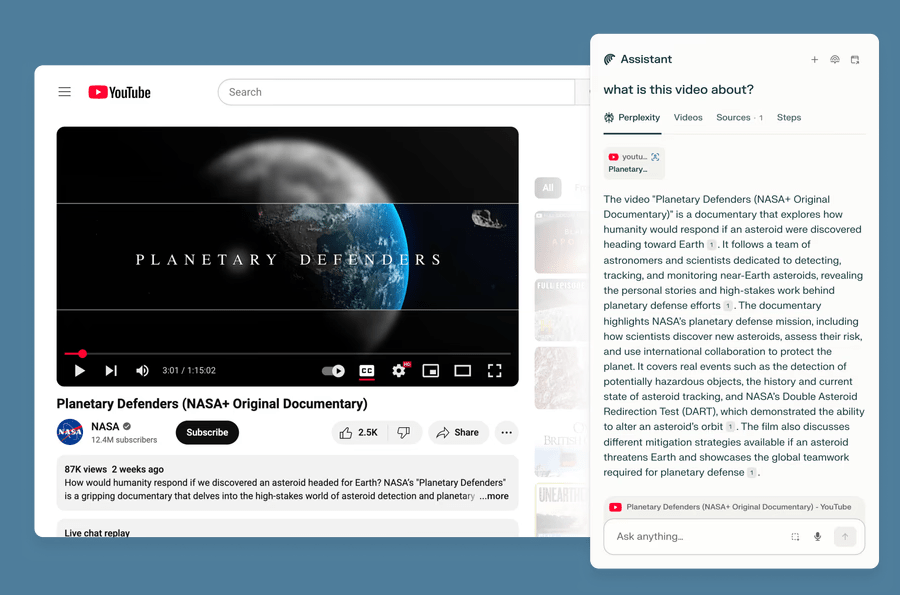
The heart of Comet is what Perplexity calls the “sidecar assistant” — an AI companion that lives alongside every tab you open. This assistant can automatically see what you’re looking at, allowing users to ask questions without opening new windows or copying and pasting text or links.
I know what you’re thinking: “Great, another chatbot that’s just going to interrupt me.” But that’s exactly what Comet doesn’t do. The assistant is there when you need it, contextually aware of the page you’re on, ready to summarize a dense research paper, explain a complex chart, or help you compare competing products — all without breaking your flow.
For designers and product people drowning in research, this changes the game. Instead of toggling between your notes app, your browser, and ChatGPT, you have a thinking partner that already knows what you’re looking at. The assistant answered questions about social media posts, YouTube videos, and even sentences users wrote in Google Docs.
Background Assistants: When AI Actually Multitasks
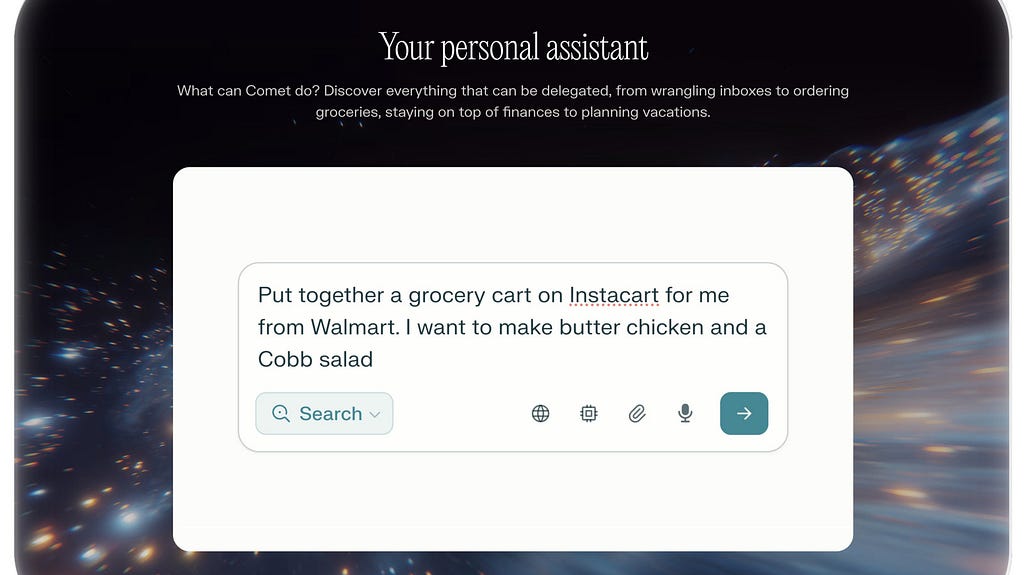
Here’s where it gets interesting. For Max subscribers ($200/month), Perplexity launched a “background assistant” described as a team of assistants that can perform multiple tasks simultaneously while users work on other things.
Think about your typical work morning: you need to send three emails, book a flight for next month, and find tickets to that conference everyone’s talking about. Normally, that’s 45 minutes of context-switching and seven open tabs. With the background assistant, you can instruct it to handle all three tasks at once, then check a mission control dashboard to monitor progress and intervene as needed.
This isn’t about replacing human judgment — notice how you can “jump in to complete tasks like hitting send on the email” or take over entirely. It’s about delegating the mechanical parts of knowledge work so you can focus on the decisions that actually matter.
The Bigger Battle Brewing
Perplexity didn’t make Comet free out of generosity. The move comes as competition heats up with rivals like Google, which rolled out Gemini in Chrome, Anthropic’s browser-based AI agent, and OpenAI’s Operator. OpenAI is reportedly releasing its own AI browser in the coming weeks, built on Chromium and designed to integrate Operator as a key feature.
We’re watching the opening moves of a new browser war, but this time the weapons aren’t speed benchmarks or rendering engines. They’re about who can build the most useful AI layer between you and the web.
Google Chrome still commands 66% market share, with Safari at 17% and Edge at 5%. But here’s the thing about browser loyalty: it only lasts until something demonstrably better shows up. Ask Netscape. Ask Internet Explorer.
The Browser Company’s Dia, another AI-first browser that launched in beta, is making similar bets. So is Opera with Neon. The pattern is clear: the browser of the future won’t just load websites. It’ll understand them.
What This Means for Product Designers
For those of us building products, three implications stand out:
1. The Interface Is Becoming Conversational
Your users are learning that they can talk to software, not just click through it. How does your product adapt when natural language becomes the primary input method?
2. Context Is Everything
Comet works by understanding the context of what you’re doing across tabs and workflows. Products that maintain conversational context across sessions will feel infinitely more intelligent than those that treat every interaction as isolated.
3. The “Assistant Layer” Is Real
We’re moving toward a world where every application has an intelligent assistant layer sitting between the user and the interface. The question isn’t whether this will happen — it’s who controls it and how much value it actually provides.
The Privacy Elephant in the Room
To use advanced features, users must give Perplexity extensive permissions, including access to view screens, send emails, access contacts, and modify calendar events. That’s a lot of trust to place in a startup’s AI.
CEO Aravind Srinivas revealed plans in May 2025 to track user activities across the internet through the browser to build comprehensive user profiles for advertising purposes. The company is explicit about this: they want to understand your behavior to serve better ads.
This is the trade we’re being asked to make — extraordinary convenience in exchange for extraordinary data access. As designers and product people, we need to wrestle with this tension in our own work. How much data do we really need to be helpful? Where’s the line between personalization and surveillance?
The Real Question
Here’s what I keep coming back to: Perplexity believes that curious people lead the world, and they’re building AI products to support the world’s curiosity. That’s a beautiful mission statement. But curiosity requires agency, not just assistance.
The test for Comet — and for every AI browser coming after it — isn’t whether it can answer our questions faster. It’s whether it helps us ask better questions. Whether it amplifies our thinking rather than replacing it. Whether it becomes a tool that expands human capability instead of just another layer of algorithmic mediation between us and the raw material of the web.
Three months ago, Perplexity thought Comet was worth $200 a month. Now they’re betting that making it free will help them own the future of how we interact with information online. Whether that bet pays off depends on something deeper than features or speed: it depends on whether an AI-powered browser can make us more curious, more productive, and more human — not less.
What do you think? Are you ready for your browser to be your teammate, or does this feel like one layer of AI too many?
References
1. CNBC. (October 2, 2025). “Perplexity AI rolls out Comet browser for free worldwide.” https://www.cnbc.com/2025/10/02/perplexity-ai-comet-browser-free-.html
2. Perplexity AI. (October 2, 2025). “The Internet is Better on Comet.” https://www.perplexity.ai/hub/blog/comet-is-now-available-to-everyone-worldwide
3. TechCrunch. (October 2, 2025). “Perplexity’s Comet AI browser now free; Max users get new ‘background assistant.’” https://techcrunch.com/2025/10/02/perplexitys-comet-ai-browser-now-free-max-users-get-new-background-assistant/
4. Perplexity AI. (July 9, 2025). “Introducing Comet: Browse at the speed of thought.” https://www.perplexity.ai/hub/blog/introducing-comet
5. TechCrunch. (July 9, 2025). “Perplexity launches Comet, an AI-powered web browser.” https://techcrunch.com/2025/07/09/perplexity-launches-comet-an-ai-powered-web-browser/
6. PPC Land. (October 2, 2025). “Perplexity releases Comet browser globally at no cost after three-month limited rollout.” https://ppc.land/perplexity-releases-comet-browser-globally-at-no-cost-after-three-month-limited-rollout/
7. TechCrunch. (July 9, 2025). “OpenAI is reportedly releasing an AI browser in the coming weeks.” https://techcrunch.com/2025/07/09/openai-is-reportedly-releasing-an-ai-browser-in-the-coming-weeks/
8. CNBC. (July 10, 2025). “OpenAI to release web browser in challenge to Google Chrome.” https://www.cnbc.com/2025/07/09/openai-to-release-web-browser-in-challenge-to-google-chrome.html
9. Startup INDIAX. (July 8, 2025). “Browser Dia vs Chrome & Edge: The Battle of AI Browsers in 2025.” https://startupindiax.com/browser-dia-vs-chrome-amp-edge-the-battle-of-ai-browsers-in-2025/
When Your Browser Becomes Your Teammate: Inside Perplexity’s Comet and the Race to Reinvent the Web was originally published in UX Planet on Medium, where people are continuing the conversation by highlighting and responding to this story.
المصدر: المصدر الأصلي
{“@context”:”https://schema.org”,”@type”:”NewsArticle”,”headline”:”When Your Browser Becomes Your Teammate: Inside Perplexity’s Comet and the Race to Reinvent the Web”,”description”:”
Last week, I watched a friend wrestle with their browser tabs for the third time that morning. Email in one tab, flight comparison site in another, concert tickets in a third, a half-drafted email buried somewhere in between. “I need an assistant,” they muttered. I thought: What if your browser were the assistant?
That’s exactly what Perplexity AI is betting on with Comet, their AI-powered browser that just went from a $200-per-month exclusive to free for everyone worldwide. And if you think this is just another browser with a chatbot bolted on, you’re missing the bigger shift happening right now.
The Browser You Didn’t Know You Were Waiting For
Perplexity initially launched Comet in July to Max subscribers for $200 monthly, and millions joined the waitlist during the limited release. Three months later, on October 2nd, they made it completely free. That kind of strategic pivot — from premium exclusivity to mass accessibility in 90 days — tells you everything about the intensity of what’s brewing in the browser space.
According to Perplexity, users who downloaded Comet increased their question-asking by 6–18 times on their first day. That’s not a marginal improvement. That’s a fundamental shift in how people interact with information online.
But here’s what makes Comet different from the dozens of “AI-enhanced” tools flooding the market: it’s not trying to replace your thinking. It’s trying to keep pace with it.
The Sidecar That Never Loses Context
The heart of Comet is what Perplexity calls the “sidecar assistant” — an AI companion that lives alongside every tab you open. This assistant can automatically see what you’re looking at, allowing users to ask questions without opening new windows or copying and pasting text or links.
I know what you’re thinking: “Great, another chatbot that’s just going to interrupt me.” But that’s exactly what Comet doesn’t do. The assistant is there when you need it, contextually aware of the page you’re on, ready to summarize a dense research paper, explain a complex chart, or help you compare competing products — all without breaking your flow.
For designers and product people drowning in research, this changes the game. Instead of toggling between your notes app, your browser, and ChatGPT, you have a thinking partner that already knows what you’re looking at. The assistant answered questions about social media posts, YouTube videos, and even sentences users wrote in Google Docs.
Background Assistants: When AI Actually Multitasks
Here’s where it gets interesting. For Max subscribers ($200/month), Perplexity launched a “background assistant” described as a team of assistants that can perform multiple tasks simultaneously while users work on other things.
Think about your typical work morning: you need to send three emails, book a flight for next month, and find tickets to that conference everyone’s talking about. Normally, that’s 45 minutes of context-switching and seven open tabs. With the background assistant, you can instruct it to handle all three tasks at once, then check a mission control dashboard to monitor progress and intervene as needed.
This isn’t about replacing human judgment — notice how you can “jump in to complete tasks like hitting send on the email” or take over entirely. It’s about delegating the mechanical parts of knowledge work so you can focus on the decisions that actually matter.
The Bigger Battle Brewing
Perplexity didn’t make Comet free out of generosity. The move comes as competition heats up with rivals like Google, which rolled out Gemini in Chrome, Anthropic’s browser-based AI agent, and OpenAI’s Operator. OpenAI is reportedly releasing its own AI browser in the coming weeks, built on Chromium and designed to integrate Operator as a key feature.
We’re watching the opening moves of a new browser war, but this time the weapons aren’t speed benchmarks or rendering engines. They’re about who can build the most useful AI layer between you and the web.
Google Chrome still commands 66% market share, with Safari at 17% and Edge at 5%. But here’s the thing about browser loyalty: it only lasts until something demonstrably better shows up. Ask Netscape. Ask Internet Explorer.
The Browser Company’s Dia, another AI-first browser that launched in beta, is making similar bets. So is Opera with Neon. The pattern is clear: the browser of the future won’t just load websites. It’ll understand them.
What This Means for Product Designers
For those of us building products, three implications stand out:
1. The Interface Is Becoming Conversational
Your users are learning that they can talk to software, not just click through it. How does your product adapt when natural language becomes the primary input method?
2. Context Is Everything
Comet works by understanding the context of what you’re doing across tabs and workflows. Products that maintain conversational context across sessions will feel infinitely more intelligent than those that treat every interaction as isolated.
3. The “Assistant Layer” Is Real
We’re moving toward a world where every application has an intelligent assistant layer sitting between the user and the interface. The question isn’t whether this will happen — it’s who controls it and how much value it actually provides.
The Privacy Elephant in the Room
To use advanced features, users must give Perplexity extensive permissions, including access to view screens, send emails, access contacts, and modify calendar events. That’s a lot of trust to place in a startup’s AI.
CEO Aravind Srinivas revealed plans in May 2025 to track user activities across the internet through the browser to build comprehensive user profiles for advertising purposes. The company is explicit about this: they want to understand your behavior to serve better ads.
This is the trade we’re being asked to make — extraordinary convenience in exchange for extraordinary data access. As designers and product people, we need to wrestle with this tension in our own work. How much data do we really need to be helpful? Where’s the line between personalization and surveillance?
The Real Question
Here’s what I keep coming back to: Perplexity believes that curious people lead the world, and they’re building AI products to support the world’s curiosity. That’s a beautiful mission statement. But curiosity requires agency, not just assistance.
The test for Comet — and for every AI browser coming after it — isn’t whether it can answer our questions faster. It’s whether it helps us ask better questions. Whether it amplifies our thinking rather than replacing it. Whether it becomes a tool that expands human capability instead of just another layer of algorithmic mediation between us and the raw material of the web.
Three months ago, Perplexity thought Comet was worth $200 a month. Now they’re betting that making it free will help them own the future of how we interact with information online. Whether that bet pays off depends on something deeper than features or speed: it depends on whether an AI-powered browser can make us more curious, more productive, and more human — not less.
What do you think? Are you ready for your browser to be your teammate, or does this feel like one layer of AI too many?
References
1. CNBC. (October 2, 2025). “Perplexity AI rolls out Comet browser for free worldwide.” https://www.cnbc.com/2025/10/02/perplexity-ai-comet-browser-free-.html
2. Perplexity AI. (October 2, 2025). “The Internet is Better on Comet.” https://www.perplexity.ai/hub/blog/comet-is-now-available-to-everyone-worldwide
3. TechCrunch. (October 2, 2025). “Perplexity’s Comet AI browser now free; Max users get new ‘background assistant.’” https://techcrunch.com/2025/10/02/perplexitys-comet-ai-browser-now-free-max-users-get-new-background-assistant/
4. Perplexity AI. (July 9, 2025). “Introducing Comet: Browse at the speed of thought.” https://www.perplexity.ai/hub/blog/introducing-comet
5. TechCrunch. (July 9, 2025). “Perplexity launches Comet, an AI-powered web browser.” https://techcrunch.com/2025/07/09/perplexity-launches-comet-an-ai-powered-web-browser/
6. PPC Land. (October 2, 2025). “Perplexity releases Comet browser globally at no cost after three-month limited rollout.” https://ppc.land/perplexity-releases-comet-browser-globally-at-no-cost-after-three-month-limited-rollout/
7. TechCrunch. (July 9, 2025). “OpenAI is reportedly releasing an AI browser in the coming weeks.” https://techcrunch.com/2025/07/09/openai-is-reportedly-releasing-an-ai-browser-in-the-coming-weeks/
8. CNBC. (July 10, 2025). “OpenAI to release web browser in challenge to Google Chrome.” https://www.cnbc.com/2025/07/09/openai-to-release-web-browser-in-challenge-to-google-chrome.html
9. Startup INDIAX. (July 8, 2025). “Browser Dia vs Chrome & Edge: The Battle of AI Browsers in 2025.” https://startupindiax.com/browser-dia-vs-chrome-amp-edge-the-battle-of-ai-browsers-in-2025/
When Your Browser Becomes Your Teammate: Inside Perplexity’s Comet and the Race to Reinvent the Web was originally published in UX Planet on Medium, where people are continuing the conversation by highlighting and responding to this story.
“,”datePublished”:”2025-10-23 12:20:42″,”author”:{“@type”:”Organization”,”name”:”العربية”},”publisher”:{“@type”:”Organization”,”name”:”Newsly”,”url”:”http://wordpress-hr2d6.wasmer.app”},”image”:”https://cdn-images-1.medium.com/max/1024/0*OU1UaQ4Wpy-l5UTr.jpg”}

Post Comment