UX 3.0


The Next Frontier of Human Experience
Inspired by the article “A User Experience 3.0 (UX 3.0) Paradigm Framework: User Experience Design for Human-Centered AI Systems”, authored by Wei Xu — chief scientist at HCAI Labs, former chairman of Intel’s HCI technical committee, and former researcher at Boeing — I decided to write this text about how the concept of UX 3.0 represents the transition from interface-centered design to design driven by intelligent agents and cognitive experiences.
This article was made available on arXiv, a service of Cornell University recognized worldwide for offering open access to more than 2.4 million peer-reviewed academic publications widely disseminated in the scientific community.
The research of Xu proposes a profound redefinition of the field of User Experience (UX), presenting the concept of “User Experience 3.0 (UX 3.0)” — a new paradigm that emerges from the integration between human-centered design and Artificial Intelligence systems.
The discipline of User Experience (UX), in my view, is at an inflection point. What was once a field focused on optimizing human-computer interaction in “unitary” digital interfaces (i.e., linked to a system or website, for example), is now expanding into a much broader and more complex dimension.
We are witnessing the advent of UX 3.0, a new era that invites us to transcend the design of “pages” to prepare a journey between ecosystems in a multiversed experience between human intelligence and artificial intelligence in a symbiosis that transcends the execution of tasks, and begins to co-create the reality of our solutions for our pains and needs.
This isn’t just an incremental evolution; it’s a fundamental redefinition of our role as designers, driven by artificial intelligence (AI), the interconnectedness of devices, and the growing demand for experiences that are not just functional, but deeply human, ethical, and emotionally resonant.
This progression marks the journey from a niche practice to a core strategic discipline in the intelligence age.
Role of the Designer
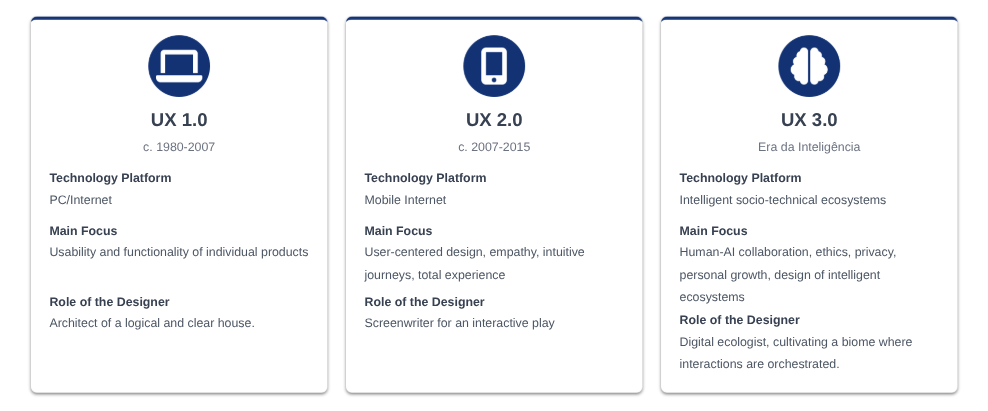
If the UX 1.0 (c. 1980–2007) was the era of usability, where the challenge was to make technology accessible and functional — like an architect designing a logical and clear house — and the UX 2.0 (c. 2007–2015) it was the era of user-centered design, focused on empathy and creating intuitive journeys, like a screenwriter of an interactive play, the UX 3.0 launches us into a territory of unprecedented complexity: the design of intelligent ecosystems.
In this new frontier, the designer ceases to be a mere creator of artifacts and becomes an ecosystem articulator, cultivating a biome where interactions between AI, humans, and contexts are orchestrated. The product becomes an adaptive organism.
In the work presented by Wei Xu, each era has distinct characteristics.
Now, the UX 3.0, in the age of intelligence(big data, AI, metaverse), addresses complex needs such as human-AI collaboration, ethics, privacy and personal growth, operating within an intelligent sociotechnical ecosystem.
We will now explore how the UX vision, according to the study, will constitute a new paradigm to be considered under 4 points.
Conceptual framework of the UX 3.0 paradigm
To guide this exploration, now in order to delve a little deeper into the topic, we will look at the conceptual framework of “UX 3.0” proposed by Xu (2024), which is based on 4 pillars of emerging experiences.
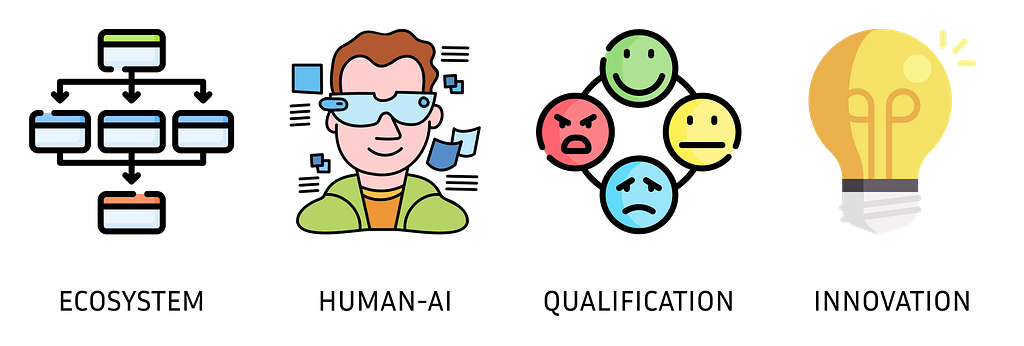
The four pillars that structure this new era are: ecosystem-based experience, a experience based on Human-AI interaction, a experience based on human interactionand toexperience through innovation.
Together, they form the foundation for a UX practice that not only responds to the challenges of the intelligence age, but anticipates them, actively shaping the way we interact with technology.
Pillar 1: Orchestrating Intelligent Ecosystems

The most fundamental paradigm shift of UX 3.0 is the transition from designing siloed products to orchestrating interconnected ecosystems.
The modern user no longer lives on a digital island, interacting with a single app or website. Instead, their journey is fluid and fragmented, spanning a constellation of touchpoints: smartphones, smartwatches, voice assistants, connected cars, smart TVs, and even home appliances.
The designer’s challenge is not to optimize a single interaction, but to ensure that the experience is cohesive, continuous, and synergistic across the entire network.
Wei Xu’s research defines this new field as “ecosystem-based experience,” arguing that UX should design for multiple intersecting touchpoints and interactions, rather than being limited to a single interface at a given moment. This expands the scope of design beyond the product interface to encompass the entire lifecycle and layers of the system architecture.
Xu identifies four types of ecosystems that the modern designer should consider:
- Throughout the entire product lifecycle: The experience is not limited to development, but extends to pre-development (branding, marketing) and post-development (AI-enabled customer support, product updates) activities.
- Through technological ecosystems: The experience must be consistent and fluid across different operating systems, devices (desktop, mobile, wearables) and online platforms (e-commerce, social networks).
- Through the layers of the system architecture: UX isn’t just a front-end layer. It relies on integration with the middle-end (business logic) and back-end (databases, data quality), requiring UX architecture design.
- Within a broad sociotechnical environment: The experience is influenced by the social, cultural and organizational macro-context, such as smart cities, smart factories or intelligent transportation systems.
This ecosystem vision is crucial. The experience of a brand like Samsung, for example, is not defined solely by its smartphone app, but by how the phone communicates with the watch, TV, and refrigerator through the SmartThings ecosystem.
A Samsung designed a connectivity framework this allows, for example, Galaxy Buds earbuds to automatically switch audio between a tablet and a smartphone when a call comes in, creating a seamless and frictionless experience for the user. This is a practical example of design for interaction between technology ecosystems.
This approach is equally vital in the corporate world. A Siemens, with its Xcelerator platform, exemplifies this approach in the industrial sector.
The platform isn’t just software, but a digital ecosystem that integrates design, engineering, and manufacturing. It allows companies to create “digital twins” of their products and factories, testing and optimizing complex systems virtually before any physical implementation.
By doing so, the Siemens doesn’t just sell a product; it offers a ecosystem for the innovation, connecting customers, partners, and developers on an open platform that accelerates digital transformation. This reflects orchestration within a complex sociotechnical environment.
Designing for ecosystems requires a systems mindset. The designer needs to map not only the user journey, but also the “dance” between different systems, anticipating how information and context should flow from one point to another.
Visual and functional consistency is just the starting point.
The real challenge is to create an experience that feels like a living, intelligent organism, where each part works in harmony to serve the user holistically.
Pillar 2: The Human-Machine Symbiosis

At the heart of UX 3.0’s intelligent ecosystems is the rise of Artificial Intelligence.
However, AI here is not just an automation tool, but an active partner in the user experience, creating a human-machine symbiosis that redefines the nature of interaction.
The goal is to transcend reactivity and achieve proactivity, where systems not only respond to commands, but anticipate needs and act as a cognitive “copilot.”
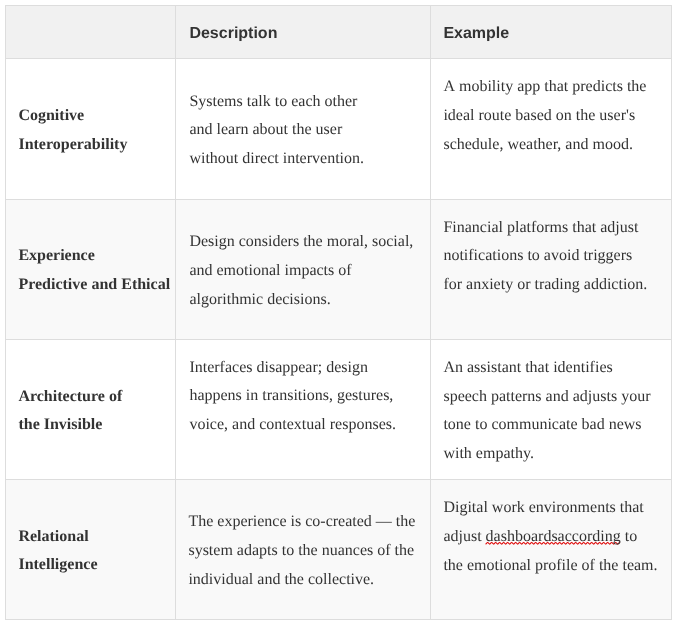
It’s what we call cognitive interoperability: systems that talk to each other and learn about the user without direct intervention.
This approach manifests itself most clearly in predictive and context-aware experiences.
AI systems and machine learning analyze behavior patterns, environmental context (such as location, time of day), and historical data to offer personalized recommendations and actions.
A Netflix is a master of this art. The company claims that 80% do content watched on your platform is driven by recommendations. Its AI system goes beyond suggesting titles; it dynamically customizes movie and series thumbnails for each user, selecting the image most likely to appeal to that specific profile.
Recently, theNetflix began to test AI searches in natural language, allowing users to order “something light and fun” and receive contextual suggestions.
The evolution of AI is also breaking down the barriers of interaction modalities, giving rise to architecture of the invisibleIn UX 3.0, traditional interfaces begin to disappear; design happens in transitions, gestures, voice, and contextual responses. Interaction ceases to be a rigid process and becomes a natural conversation.
THE Apple Vision Pro is a milestone in this regard, allowing users to control the interface through a intuitive combination of eye tracking, hand gestures and voice commandsThere’s no need for a mouse or physical controller; the user’s body is the interface. This fusion of modalities creates a “spatial computing” experience that feels less like using a computer and more like interacting directly with the digital world.
This phenomenon aligns directly with the pillar of experience based on Human-AI interaction, as described by Wei Xu.
Traditional interaction (HCI) is transforming into collaboration where both humans and AI agents can initiate interactions.
New AI characteristics, such as autonomy and learning, bring unique challenges and opportunities. For example, AI’s “black box” requires the development of a Explainable AI (XAI), where the interface design must make algorithmic processes transparent and understandable to the user, building trust.
Interaction is no longer based on “precise inputs” but on the interpretation of intent and context, leading to richer social and emotional interactions.
Asian tech giants are also at the forefront of multimodal AI. Alibaba, with its model Qwen, developed an AI capable of understand and generate content from multiple sources, such as text and images, with high precision.
A Tencent, technology and communications conglomerate that acts as a holding company — owner of Wechat, QQ and has a 40% stake in Epic Games, in turn applies AI to create more natural and engaging interactionsin its social and gaming products, personalizing recommendations and experiences.
These technologies are not limited to a single form of input or output, but combine different senses to create richer, more human communication between user and machine.
Pillar 3 — Experience Based on Human-AI Interaction
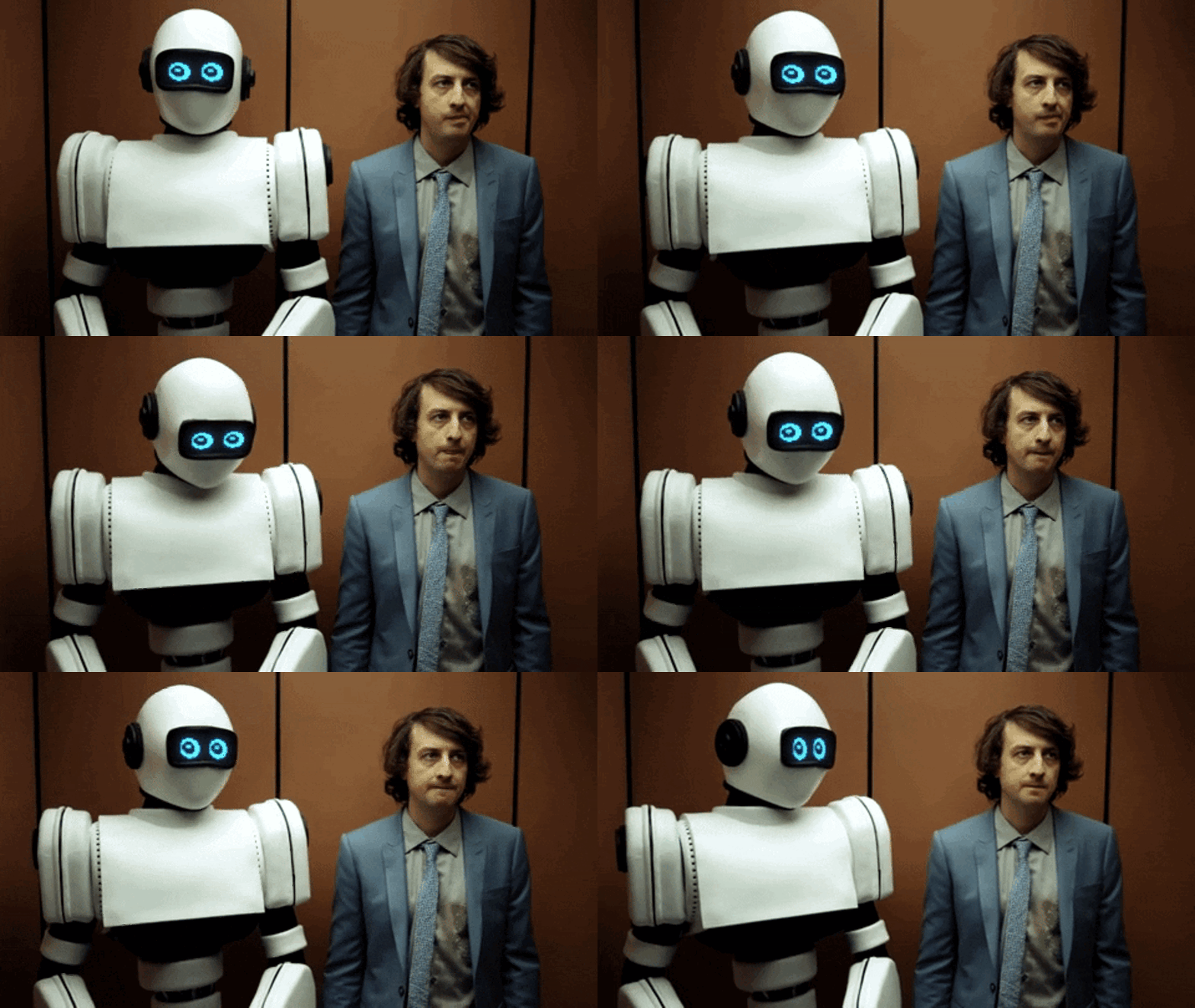
Human-computer interaction, traditionally studied in the field of HCI (Human-Computer Interaction), is undergoing a profound transformation. Previously, the focus was on understanding how people interacted with non-intelligent systems.
AI systems possess unique characteristics, such as autonomous learning and the ability to execute independently. In many cases, they exhibit human-like behaviors, learning from data, adapting to context, and even making decisions automatically.
On the one hand, this enables more natural, fluid, and personalized experiences. On the other, it presents unprecedented challenges: traditional design and research methods cannot address the unpredictability, algorithmic bias, and lack of transparency that often accompany these systems.
In this new scenario, experience design needs to consider different dimensions.
First, it is necessary to understand that AI has evolutionary behaviors and that these behaviors can change over time as the system learns.
Therefore, the experience needs to include ways to monitor and adjust AI behavior, maintaining human control and preventing blind trust in automatic responses.
This underscores the importance of explainable AI. Because many systems operate as “black boxes,” it’s essential to create experiences that make AI operations more transparent, helping users understand why a decision was made. This increases trust and a sense of security during use.
Furthermore, intelligent interfaces are emerging, allowing both humans and systems to initiate interactions. Instead of relying on precise commands, AI interprets intentions, emotions, and context. This enables more natural and empathetic experiences, bringing the dialogue between humans and machines closer together.
Finally, it is essential to address the issue of ethical AI. As AI becomes part of everyday life, new values come into play — such as privacy, equity, autonomy, and accountability.
Experience design needs to reflect these concerns, striving not only for usability but also for fairness, transparency, and respect for people (Xu & Gao, 2024).
The rise of AI intensifies these ethical challenges. Algorithms can perpetuate and amplify existing biases in training data, leading to unfair or discriminatory results. As the Human-Centered AI (HCAI) framework points out, new user needs, such as fairness, ethics, skill development, and decision-making authority, go beyond conventional usability needs.
Stanford’s work (HCAI) explores how incorporate diverse human and cultural values in AI systems, ensuring that the technology serves to enhance human capabilities, not replace or undermine them.
The UX 3.0 designer must therefore be an active participant in these discussions, collaborating with data scientists and engineers to audit algorithms, identify biases, and advocate for solutions that are fair, transparent, and accountable.
Pillar 4: Co-creation and Relational Intelligence

The complexity of UX 3.0 demands a significant expansion of the designer’s arsenal of tools and methodologies. Traditional user-centered design practices, while still valuable, are no longer sufficient.
The modern designer must become a polymath, fluent in a diverse range of approaches that enable collaboration at scale, continuous learning, and systemic innovation.
This need directly reflects the pillars of innovation-enabled experienceand theAI-enabled experience do framework de Xu.
One of the most powerful methodologies in this new era is co-creation, which gives rise to the concept of relational intelligence. Rather than treating users as passive research subjects, co-creation elevates them to the position of active partners in the design process.
They are brought into workshops, brainstorming, and prototyping sessions, directly contributing their ideas and insights. This approach, championed by institutions such as the MIT Co-Creation Studio, democratizes the creative process and ensures that solutions are deeply rooted in users’ reality.
The LEGO Ideas platform is a commercially successful example of how the community not only validates but also generates products that become bestsellers. By allowing fans to submit and vote on new designs, LEGO harnesses collective creativity and ensures market alignment before even starting production.
Co-creation is often fueled by a cycle ofcontinuous feedback. In contrast to annual assessments or sporadic surveys, agile organizations establish a constant flow of communication with their users and within their teams.
Data analysis tools, A/B testing, and direct communication channels allow companies to gather and react to insights in real time. This practice not only accelerates development but also fosters a culture of learning and adaptation.
According to a Gallup survey, companies that implement continuous feedback see an increase in 14.9% in talent retention, demonstrating its positive impact on organizational culture.
Spotify exemplifies the application of these principles in a highly complex ecosystem. The company has developed a distributed design system called Encore(Global Language Unified Experience), which functions as a “family of design systems”.
Instead of a single centralized team becoming a bottleneck, Encore enables distributed teams across more than 45 different platforms contribute to the evolution of the user experience. This federated model, built on a foundation ofdesign tokens shared, allows Spotify to maintain brand consistency while promoting autonomy and innovation at scale.
Furthermore, AI itself is becoming a tool for the designer.
A AI-enabled experience it refers not only to the end user experience, but also to the UX professional experience.
Generative AI tools like ChatGPT, Bard, and Adobe Firefly can help with user research (analyzing interview transcripts), UI design (generating prototypes), and validation (analyzing multimodal test data).
While these tools won’t replace creative design yet, they promise to increase efficiency and allow designers to focus on more strategic challenges.
To manage this complexity, UX 3.0 designers need maturity models to assess and guide the evolution of their organizations.
The Nielsen Norman Group’s UX maturity model, for example, describes six stages, from “Absent” (where UX is ignored) to “User-Driven” (where user-centered design is the norm). These models help teams identify their strengths and weaknesses and chart a strategic path to integrate UX more deeply into the company’s culture and processes.
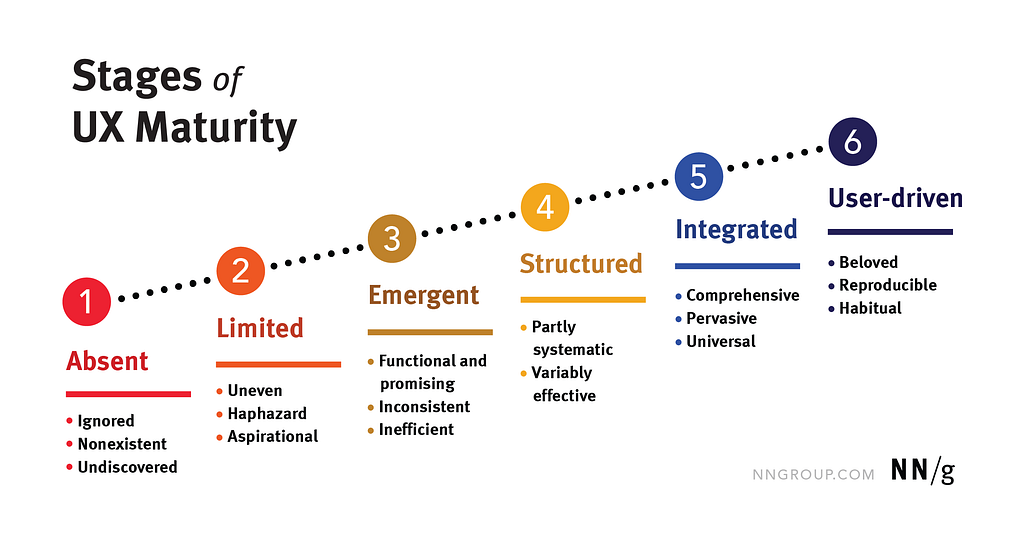
The journey to UX maturity is a collective effort that requires leadership support, a culture of collaboration, and structured processes for measuring design impact.
Cases and the era of UX 3.0
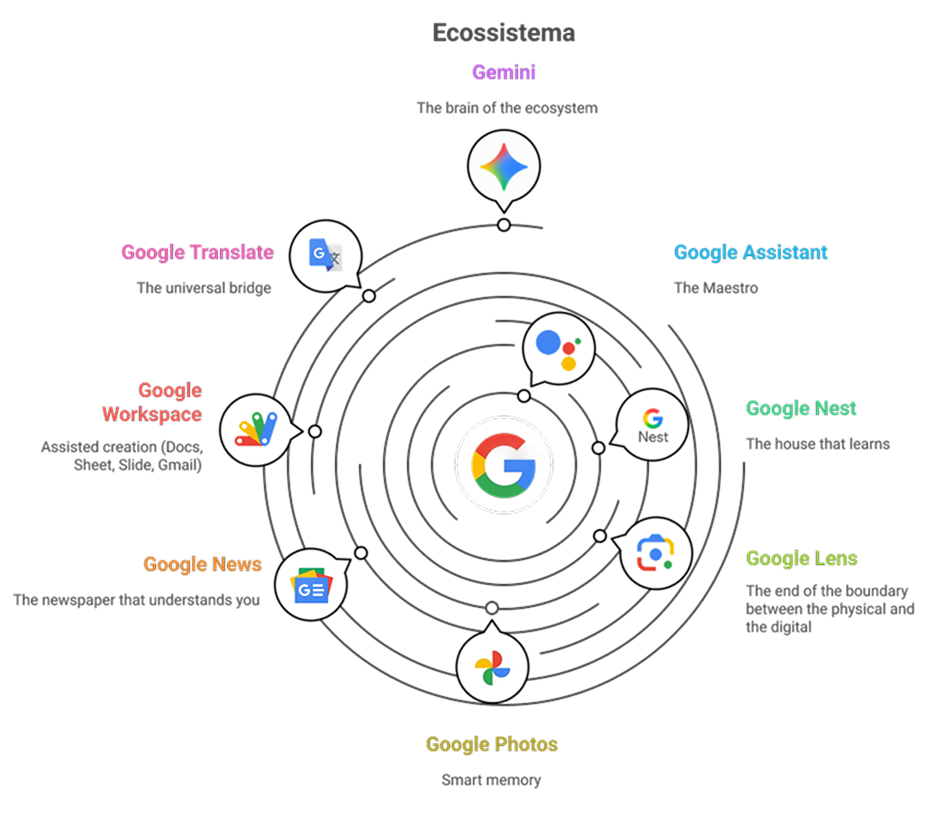
The advent of UX 3.0 represents a profound transformation in the way we think about design. We’ve moved beyond screen optimization and entered the era of orchestrated intelligent ecosystems, where products, services, and devices interconnect in a seamless, nearly invisible experience.
In this new frontier — shaped by the ubiquity of artificial intelligence and the integration of the physical and digital worlds — Google positions itself as one of the key architects of this emerging reality. More than just creating tools, the company builds environments for technological coexistence, where each product learns, responds, and collaborates in harmony.
Google Assistant: The Maestro
At the center of this symphony is Google Assistant, the conductor that coordinates interactions between all services. It has gone from being just a voice interface to a cognitive layer that connects the user to the ecosystem.
The Assistant observes patterns, learns behaviors, and acts autonomously — adjusting routines, suggesting actions, and even anticipating needs. Whether on a smartphone, in a car with Android Auto, or on a Nest device, the experience is seamless, contextual, and adaptive. Voice is not just a command, but a natural extension of thought. Design, once visual, is now behavioral.
Google Nest: The Home That Learns
Google Nest translates the concept of UX 3.0 into the home environment. It’s design becoming environment. Thermostats that learn your schedule, cameras that identify people, lights that respond to voice, and automated routines that make everyday life more fluid and human.
When you say “Ok Google, good morning,” the system adjusts the temperature, turns on the lights, reads the news, and plays your favorite playlist — all seamlessly. Your home adapts to you. Technology disappears into the experience, and it’s in this disappearance that the magic happens.
Google Lens: The End of the Boundary Between the Physical and the Digital
With Google Lens, Google has dissolved the separation between seeing and understanding. The camera has gone from being a simple image capturer to a cognitive tool. By pointing it at an object, text, or location, Lens interprets, translates, suggests, compares, and connects.
It translates signs in real time, identifies plants, offers purchase links, and explains what you see. Each click is a new layer of meaning — a bridge between the physical and digital worlds. It’s design transforming into contextual interpretation.
Google Photos: The Smart Memory
Google Photos is perhaps the most sensitive example of UX 3.0: it doesn’t just store images — it understands memories. Using facial and object recognition, the system groups photos of people, animals, and places, enabling natural searches like “photos of John at the beach.”
AI automatically creates videos, collages, animations, and highlights of memorable moments without the user needing to ask. And with intelligent editing, Google Photos suggests corrections, ideal lighting, and even removal of unwanted objects. More than just preserving memories, it reinterprets them, transforming the accumulation of visual data into emotional narratives. The technology here isn’t about pixels, but about emotion and meaning.
Google News: The Newspaper That Understands You
With Google News, information design enters its most empathetic phase. AI analyzes interests, reading patterns, and context to deliver a personalized feed that balances timeliness and relevance. Unlike legacy news portals, News isn’t static — it learns from the reader.
Every click, every swipe, every silent preference shapes a dynamic curation that renews itself in real time. It’s UX 3.0 applied to attention: a design that respects each person’s time, interests, and rhythm.
Google Workspace:
Google Workspace is the productive face of this new era — where artificial intelligence acts as an assistant, writer, analyst, and proofreader.
a) Gmail: Smart Communication
Gmail has become a cognitive filter for digital chaos. Using machine learning, it detects and blocks spam and phishing attempts with near-perfect accuracy.
Features like Smart Compose and Smart Reply anticipate your intentions, suggesting complete replies or sentence fragments as you type. And with Priority Inbox, the system automatically organizes important messages, separating them from promotions and social notifications. The experience is focused and fluid — email stops being a task and becomes an ongoing conversation with intelligence.
b) Docs, Sheets and Slides: Assisted Creation
Google adds a layer of collaborative AI to its creative tools. The Explore feature suggests graphics, formatting, and contextual information based on written content. The system offers intelligent grammatical corrections, detecting nuances in tone and clarity. AI here doesn’t replace the creator — it augments them. Design becomes co-authored, and the production process becomes a dance between human and machine.

Google Translate: The Universal Bridge
Google Translate represents one of the most beautiful examples of technology serving human understanding. With Neural Machine Translation (NMT), the system doesn’t translate word by word, but rather interprets entire sentences, capturing context and intent. This results in more natural, human, and accurate translations.
With Word Lens, simply point your camera at text in another language — and the words transform before your eyes, in real time. It’s language crossing borders seamlessly. Design becomes instant cross-cultural understanding.
Gemini: The Brain of the Ecosystem
At the apex of this orchestra, Google Gemini emerges — the one that understands, connects. It is the multimodal foundation that unifies all experiences: text, image, sound, video, and code.
Gemini doesn’t translate formats — it thinks through them. This enables true human-machine symbiosis, where the user expresses an intention and the system responds holistically.
It’s the brain that makes the ecosystem vibrate in unison. With it, Google transforms its constellation of products into an intelligent and cohesive organism, capable of understanding the world, context, and people with unprecedented fluidity.
Core Features of UX 3.0
Finally…
The UX 3.0 designer is, by necessity, a systems thinker, a strategist, and a humanist. They design not just a product, but the complex network of interactions surrounding it, ensuring a fluid and cohesive experience across an ecosystem of devices and services.
It not only responds to user needs, but anticipates them, collaborating with artificial intelligence to create predictive and contextual experiences that seem almost magical in their relevance.
Most importantly, the UX 3.0 designer is an ethical guardian. With the power to influence behavior and emotions on an unprecedented scale comes the responsibility to design consciously, prioritizing digital well-being, privacy, transparency, and equity.
The quest is not just for engagement, but for engagement that enriches human life, that fosters connection, and that empowers rather than manipulates.
The technologies that define this new era — generative AI, extended reality, multimodal interactions — are still in their infancy. Interaction with AI, often explicit today, will become increasingly ambient and invisible, just as the internet has dissolved into the fabric of our daily lives.
In this fast-moving future, the designer’s role will be less about creating artifacts and more about curating intelligent systems and facilitating collaboration between humans and machines.
The horizon is vast and full of possibilities that challenge our imagination.
The path ahead will require continuous learning, adaptability, and the courage to embrace complexity. As architects of future realities, we have the opportunity and the duty to shape a world where technology not only serves humanity, but elevates it.
The future isn’t something that just happens; it’s something we design. And that future is undoubtedly exciting.
References
- Apple. (n.d.). Apple Vision Pro. Accessed in 2025.
- Gallup. (n.d.). The impact of continuous feedback on professional development. Psycho Smart.
- Google Developers. (n.d.). Tuya’s Success with Google Home APIs: Real-Time Management…
- McGregor, S. (2023). AI Incidents Database. https://incidentdatabase.ai/.
- MIT Co-Creation Studio. (n.d.). Co Creation Studio. Accessed in 2025.
- Neointeraction. (n.d.). Headspace: A Case Study On Successful Emotion-Driven ux/ui Design.
- Netflix Technology Blog. (n.d.). Unveiling Our Innovative New TV Experience.
- Nielsen Norman Group. (n.d.). The 6 Levels of UX Maturity.
- Norman, D. A. (n.d.). Emotional Design: Why We Love (or Hate) Everyday Things. Nielsen Norman Group.
- PUCRS Online. (n.d.). Success Stories in Brand Collaboration with Clients.
- Samsung. (n.d.). What is the Galaxy Ecosystem that enables connected living?.
- SAP. (n.d.). Personalization for B2B Profit: Using AI to Improve….
- Siemens. (n.d.). Design a Business Ecosystem strategy | Siemens Xcelerator.
- Spotify Design. (n.d.). Reimagining Design Systems at Spotify.
- Stanford HAI. (n.d.). Design, Human-Computer Interaction.
- Stanford HAI. (2022). 2022 AI Index: AI’s Ethical Growing Pains
- Tencent. (n.d.). Artificial Intelligence.
- UserGuiding. (n.d.). 9 UX Examples Every Designer Should Know.
- UX Design CC. (n.d.). UX 3.0: Design in motion and continuous evolution of the discipline.
- UX Design Institute. (n.d.). The history of UX (User Experience).
Reference consulted directly:
- Xu, W. (2024).User-centered design (IX): A “User Experience 3.0” paradigm framework in the intelligence era. Journal of Applied Psychology, 30.
Indirectly cited references (apud Xu, 2024):
- Xu, W. (2012).User experience design: Beyond user interface design and usability. In Ergonomics — A systems approach. IntechOpen.
- Xu, W. (2018).User-centered design (III): Methods for user experience and innovative design in the intelligent era. Journal of Applied Psychology, 25(1), 3–17.
- Xu, W. (2019).Toward human-centered AI: A perspective from human–computer interaction. Interactions, 26(4), 42–46.
- Xu, W., & Gao, Z. (2024). An intelligent sociotechnical systems (iSTS) framework: Toward a sociotechnically-based hierarchical human-centered AI approach. arXiv preprint arXiv:2401.03223.
- Xu, W., Gao, Z., & Dainoff, M. (2024). An HCAI methodological framework: Putting it into action to enable human-centered AI. arXiv preprint arXiv:2311.16027.
- Yang, Q., et al. (2020).Re-examining whether, why, and how human–AI interaction is uniquely difficult to design. In Proceedings of the 2020 CHI Conference on Human Factors in Computing Systems (pp. xxxx–xxxx). ACM.
UX 3.0 was originally published in UX Planet on Medium, where people are continuing the conversation by highlighting and responding to this story.
المصدر: المصدر الأصلي
{“@context”:”https://schema.org”,”@type”:”NewsArticle”,”headline”:”UX 3.0″,”description”:”
The Next Frontier of Human Experience
Inspired by the article “A User Experience 3.0 (UX 3.0) Paradigm Framework: User Experience Design for Human-Centered AI Systems”, authored by Wei Xu — chief scientist at HCAI Labs, former chairman of Intel’s HCI technical committee, and former researcher at Boeing — I decided to write this text about how the concept of UX 3.0 represents the transition from interface-centered design to design driven by intelligent agents and cognitive experiences.
This article was made available on arXiv, a service of Cornell University recognized worldwide for offering open access to more than 2.4 million peer-reviewed academic publications widely disseminated in the scientific community.
The research of Xu proposes a profound redefinition of the field of User Experience (UX), presenting the concept of “User Experience 3.0 (UX 3.0)” — a new paradigm that emerges from the integration between human-centered design and Artificial Intelligence systems.
The discipline of User Experience (UX), in my view, is at an inflection point. What was once a field focused on optimizing human-computer interaction in “unitary” digital interfaces (i.e., linked to a system or website, for example), is now expanding into a much broader and more complex dimension.
We are witnessing the advent of UX 3.0, a new era that invites us to transcend the design of “pages” to prepare a journey between ecosystems in a multiversed experience between human intelligence and artificial intelligence in a symbiosis that transcends the execution of tasks, and begins to co-create the reality of our solutions for our pains and needs.
This isn’t just an incremental evolution; it’s a fundamental redefinition of our role as designers, driven by artificial intelligence (AI), the interconnectedness of devices, and the growing demand for experiences that are not just functional, but deeply human, ethical, and emotionally resonant.
This progression marks the journey from a niche practice to a core strategic discipline in the intelligence age.
Role of the Designer
If the UX 1.0 (c. 1980–2007) was the era of usability, where the challenge was to make technology accessible and functional — like an architect designing a logical and clear house — and the UX 2.0 (c. 2007–2015) it was the era of user-centered design, focused on empathy and creating intuitive journeys, like a screenwriter of an interactive play, the UX 3.0 launches us into a territory of unprecedented complexity: the design of intelligent ecosystems.
In this new frontier, the designer ceases to be a mere creator of artifacts and becomes an ecosystem articulator, cultivating a biome where interactions between AI, humans, and contexts are orchestrated. The product becomes an adaptive organism.
In the work presented by Wei Xu, each era has distinct characteristics.
Now, the UX 3.0, in the age of intelligence(big data, AI, metaverse), addresses complex needs such as human-AI collaboration, ethics, privacy and personal growth, operating within an intelligent sociotechnical ecosystem.
We will now explore how the UX vision, according to the study, will constitute a new paradigm to be considered under 4 points.
Conceptual framework of the UX 3.0 paradigm
To guide this exploration, now in order to delve a little deeper into the topic, we will look at the conceptual framework of “UX 3.0” proposed by Xu (2024), which is based on 4 pillars of emerging experiences.
The four pillars that structure this new era are: ecosystem-based experience, a experience based on Human-AI interaction, a experience based on human interactionand toexperience through innovation.
Together, they form the foundation for a UX practice that not only responds to the challenges of the intelligence age, but anticipates them, actively shaping the way we interact with technology.
Pillar 1: Orchestrating Intelligent Ecosystems
The most fundamental paradigm shift of UX 3.0 is the transition from designing siloed products to orchestrating interconnected ecosystems.
The modern user no longer lives on a digital island, interacting with a single app or website. Instead, their journey is fluid and fragmented, spanning a constellation of touchpoints: smartphones, smartwatches, voice assistants, connected cars, smart TVs, and even home appliances.
The designer’s challenge is not to optimize a single interaction, but to ensure that the experience is cohesive, continuous, and synergistic across the entire network.
Wei Xu’s research defines this new field as “ecosystem-based experience,” arguing that UX should design for multiple intersecting touchpoints and interactions, rather than being limited to a single interface at a given moment. This expands the scope of design beyond the product interface to encompass the entire lifecycle and layers of the system architecture.
Xu identifies four types of ecosystems that the modern designer should consider:
- Throughout the entire product lifecycle: The experience is not limited to development, but extends to pre-development (branding, marketing) and post-development (AI-enabled customer support, product updates) activities.
- Through technological ecosystems: The experience must be consistent and fluid across different operating systems, devices (desktop, mobile, wearables) and online platforms (e-commerce, social networks).
- Through the layers of the system architecture: UX isn’t just a front-end layer. It relies on integration with the middle-end (business logic) and back-end (databases, data quality), requiring UX architecture design.
- Within a broad sociotechnical environment: The experience is influenced by the social, cultural and organizational macro-context, such as smart cities, smart factories or intelligent transportation systems.
This ecosystem vision is crucial. The experience of a brand like Samsung, for example, is not defined solely by its smartphone app, but by how the phone communicates with the watch, TV, and refrigerator through the SmartThings ecosystem.
A Samsung designed a connectivity framework this allows, for example, Galaxy Buds earbuds to automatically switch audio between a tablet and a smartphone when a call comes in, creating a seamless and frictionless experience for the user. This is a practical example of design for interaction between technology ecosystems.
This approach is equally vital in the corporate world. A Siemens, with its Xcelerator platform, exemplifies this approach in the industrial sector.
The platform isn’t just software, but a digital ecosystem that integrates design, engineering, and manufacturing. It allows companies to create “digital twins” of their products and factories, testing and optimizing complex systems virtually before any physical implementation.
By doing so, the Siemens doesn’t just sell a product; it offers a ecosystem for the innovation, connecting customers, partners, and developers on an open platform that accelerates digital transformation. This reflects orchestration within a complex sociotechnical environment.
Designing for ecosystems requires a systems mindset. The designer needs to map not only the user journey, but also the “dance” between different systems, anticipating how information and context should flow from one point to another.
Visual and functional consistency is just the starting point.
The real challenge is to create an experience that feels like a living, intelligent organism, where each part works in harmony to serve the user holistically.
Pillar 2: The Human-Machine Symbiosis
At the heart of UX 3.0’s intelligent ecosystems is the rise of Artificial Intelligence.
However, AI here is not just an automation tool, but an active partner in the user experience, creating a human-machine symbiosis that redefines the nature of interaction.
The goal is to transcend reactivity and achieve proactivity, where systems not only respond to commands, but anticipate needs and act as a cognitive “copilot.”
It’s what we call cognitive interoperability: systems that talk to each other and learn about the user without direct intervention.
This approach manifests itself most clearly in predictive and context-aware experiences.
AI systems and machine learning analyze behavior patterns, environmental context (such as location, time of day), and historical data to offer personalized recommendations and actions.
A Netflix is a master of this art. The company claims that 80% do content watched on your platform is driven by recommendations. Its AI system goes beyond suggesting titles; it dynamically customizes movie and series thumbnails for each user, selecting the image most likely to appeal to that specific profile.
Recently, theNetflix began to test AI searches in natural language, allowing users to order “something light and fun” and receive contextual suggestions.
The evolution of AI is also breaking down the barriers of interaction modalities, giving rise to architecture of the invisibleIn UX 3.0, traditional interfaces begin to disappear; design happens in transitions, gestures, voice, and contextual responses. Interaction ceases to be a rigid process and becomes a natural conversation.
THE Apple Vision Pro is a milestone in this regard, allowing users to control the interface through a intuitive combination of eye tracking, hand gestures and voice commandsThere’s no need for a mouse or physical controller; the user’s body is the interface. This fusion of modalities creates a “spatial computing” experience that feels less like using a computer and more like interacting directly with the digital world.
This phenomenon aligns directly with the pillar of experience based on Human-AI interaction, as described by Wei Xu.
Traditional interaction (HCI) is transforming into collaboration where both humans and AI agents can initiate interactions.
New AI characteristics, such as autonomy and learning, bring unique challenges and opportunities. For example, AI’s “black box” requires the development of a Explainable AI (XAI), where the interface design must make algorithmic processes transparent and understandable to the user, building trust.
Interaction is no longer based on “precise inputs” but on the interpretation of intent and context, leading to richer social and emotional interactions.
Asian tech giants are also at the forefront of multimodal AI. Alibaba, with its model Qwen, developed an AI capable of understand and generate content from multiple sources, such as text and images, with high precision.
A Tencent, technology and communications conglomerate that acts as a holding company — owner of Wechat, QQ and has a 40% stake in Epic Games, in turn applies AI to create more natural and engaging interactionsin its social and gaming products, personalizing recommendations and experiences.
These technologies are not limited to a single form of input or output, but combine different senses to create richer, more human communication between user and machine.
Pillar 3 — Experience Based on Human-AI Interaction
Human-computer interaction, traditionally studied in the field of HCI (Human-Computer Interaction), is undergoing a profound transformation. Previously, the focus was on understanding how people interacted with non-intelligent systems.
AI systems possess unique characteristics, such as autonomous learning and the ability to execute independently. In many cases, they exhibit human-like behaviors, learning from data, adapting to context, and even making decisions automatically.
On the one hand, this enables more natural, fluid, and personalized experiences. On the other, it presents unprecedented challenges: traditional design and research methods cannot address the unpredictability, algorithmic bias, and lack of transparency that often accompany these systems.
In this new scenario, experience design needs to consider different dimensions.
First, it is necessary to understand that AI has evolutionary behaviors and that these behaviors can change over time as the system learns.
Therefore, the experience needs to include ways to monitor and adjust AI behavior, maintaining human control and preventing blind trust in automatic responses.
This underscores the importance of explainable AI. Because many systems operate as “black boxes,” it’s essential to create experiences that make AI operations more transparent, helping users understand why a decision was made. This increases trust and a sense of security during use.
Furthermore, intelligent interfaces are emerging, allowing both humans and systems to initiate interactions. Instead of relying on precise commands, AI interprets intentions, emotions, and context. This enables more natural and empathetic experiences, bringing the dialogue between humans and machines closer together.
Finally, it is essential to address the issue of ethical AI. As AI becomes part of everyday life, new values come into play — such as privacy, equity, autonomy, and accountability.
Experience design needs to reflect these concerns, striving not only for usability but also for fairness, transparency, and respect for people (Xu & Gao, 2024).
The rise of AI intensifies these ethical challenges. Algorithms can perpetuate and amplify existing biases in training data, leading to unfair or discriminatory results. As the Human-Centered AI (HCAI) framework points out, new user needs, such as fairness, ethics, skill development, and decision-making authority, go beyond conventional usability needs.
Stanford’s work (HCAI) explores how incorporate diverse human and cultural values in AI systems, ensuring that the technology serves to enhance human capabilities, not replace or undermine them.
The UX 3.0 designer must therefore be an active participant in these discussions, collaborating with data scientists and engineers to audit algorithms, identify biases, and advocate for solutions that are fair, transparent, and accountable.
Pillar 4: Co-creation and Relational Intelligence
The complexity of UX 3.0 demands a significant expansion of the designer’s arsenal of tools and methodologies. Traditional user-centered design practices, while still valuable, are no longer sufficient.
The modern designer must become a polymath, fluent in a diverse range of approaches that enable collaboration at scale, continuous learning, and systemic innovation.
This need directly reflects the pillars of innovation-enabled experienceand theAI-enabled experience do framework de Xu.
One of the most powerful methodologies in this new era is co-creation, which gives rise to the concept of relational intelligence. Rather than treating users as passive research subjects, co-creation elevates them to the position of active partners in the design process.
They are brought into workshops, brainstorming, and prototyping sessions, directly contributing their ideas and insights. This approach, championed by institutions such as the MIT Co-Creation Studio, democratizes the creative process and ensures that solutions are deeply rooted in users’ reality.
The LEGO Ideas platform is a commercially successful example of how the community not only validates but also generates products that become bestsellers. By allowing fans to submit and vote on new designs, LEGO harnesses collective creativity and ensures market alignment before even starting production.
Co-creation is often fueled by a cycle ofcontinuous feedback. In contrast to annual assessments or sporadic surveys, agile organizations establish a constant flow of communication with their users and within their teams.
Data analysis tools, A/B testing, and direct communication channels allow companies to gather and react to insights in real time. This practice not only accelerates development but also fosters a culture of learning and adaptation.
According to a Gallup survey, companies that implement continuous feedback see an increase in 14.9% in talent retention, demonstrating its positive impact on organizational culture.
Spotify exemplifies the application of these principles in a highly complex ecosystem. The company has developed a distributed design system called Encore(Global Language Unified Experience), which functions as a “family of design systems”.
Instead of a single centralized team becoming a bottleneck, Encore enables distributed teams across more than 45 different platforms contribute to the evolution of the user experience. This federated model, built on a foundation ofdesign tokens shared, allows Spotify to maintain brand consistency while promoting autonomy and innovation at scale.
Furthermore, AI itself is becoming a tool for the designer.
A AI-enabled experience it refers not only to the end user experience, but also to the UX professional experience.
Generative AI tools like ChatGPT, Bard, and Adobe Firefly can help with user research (analyzing interview transcripts), UI design (generating prototypes), and validation (analyzing multimodal test data).
While these tools won’t replace creative design yet, they promise to increase efficiency and allow designers to focus on more strategic challenges.
To manage this complexity, UX 3.0 designers need maturity models to assess and guide the evolution of their organizations.
The Nielsen Norman Group’s UX maturity model, for example, describes six stages, from “Absent” (where UX is ignored) to “User-Driven” (where user-centered design is the norm). These models help teams identify their strengths and weaknesses and chart a strategic path to integrate UX more deeply into the company’s culture and processes.
The journey to UX maturity is a collective effort that requires leadership support, a culture of collaboration, and structured processes for measuring design impact.
Cases and the era of UX 3.0
The advent of UX 3.0 represents a profound transformation in the way we think about design. We’ve moved beyond screen optimization and entered the era of orchestrated intelligent ecosystems, where products, services, and devices interconnect in a seamless, nearly invisible experience.
In this new frontier — shaped by the ubiquity of artificial intelligence and the integration of the physical and digital worlds — Google positions itself as one of the key architects of this emerging reality. More than just creating tools, the company builds environments for technological coexistence, where each product learns, responds, and collaborates in harmony.
Google Assistant: The Maestro
At the center of this symphony is Google Assistant, the conductor that coordinates interactions between all services. It has gone from being just a voice interface to a cognitive layer that connects the user to the ecosystem.
The Assistant observes patterns, learns behaviors, and acts autonomously — adjusting routines, suggesting actions, and even anticipating needs. Whether on a smartphone, in a car with Android Auto, or on a Nest device, the experience is seamless, contextual, and adaptive. Voice is not just a command, but a natural extension of thought. Design, once visual, is now behavioral.
Google Nest: The Home That Learns
Google Nest translates the concept of UX 3.0 into the home environment. It’s design becoming environment. Thermostats that learn your schedule, cameras that identify people, lights that respond to voice, and automated routines that make everyday life more fluid and human.
When you say “Ok Google, good morning,” the system adjusts the temperature, turns on the lights, reads the news, and plays your favorite playlist — all seamlessly. Your home adapts to you. Technology disappears into the experience, and it’s in this disappearance that the magic happens.
Google Lens: The End of the Boundary Between the Physical and the Digital
With Google Lens, Google has dissolved the separation between seeing and understanding. The camera has gone from being a simple image capturer to a cognitive tool. By pointing it at an object, text, or location, Lens interprets, translates, suggests, compares, and connects.
It translates signs in real time, identifies plants, offers purchase links, and explains what you see. Each click is a new layer of meaning — a bridge between the physical and digital worlds. It’s design transforming into contextual interpretation.
Google Photos: The Smart Memory
Google Photos is perhaps the most sensitive example of UX 3.0: it doesn’t just store images — it understands memories. Using facial and object recognition, the system groups photos of people, animals, and places, enabling natural searches like “photos of John at the beach.”
AI automatically creates videos, collages, animations, and highlights of memorable moments without the user needing to ask. And with intelligent editing, Google Photos suggests corrections, ideal lighting, and even removal of unwanted objects. More than just preserving memories, it reinterprets them, transforming the accumulation of visual data into emotional narratives. The technology here isn’t about pixels, but about emotion and meaning.
Google News: The Newspaper That Understands You
With Google News, information design enters its most empathetic phase. AI analyzes interests, reading patterns, and context to deliver a personalized feed that balances timeliness and relevance. Unlike legacy news portals, News isn’t static — it learns from the reader.
Every click, every swipe, every silent preference shapes a dynamic curation that renews itself in real time. It’s UX 3.0 applied to attention: a design that respects each person’s time, interests, and rhythm.
Google Workspace:
Google Workspace is the productive face of this new era — where artificial intelligence acts as an assistant, writer, analyst, and proofreader.
a) Gmail: Smart Communication
Gmail has become a cognitive filter for digital chaos. Using machine learning, it detects and blocks spam and phishing attempts with near-perfect accuracy.
Features like Smart Compose and Smart Reply anticipate your intentions, suggesting complete replies or sentence fragments as you type. And with Priority Inbox, the system automatically organizes important messages, separating them from promotions and social notifications. The experience is focused and fluid — email stops being a task and becomes an ongoing conversation with intelligence.
b) Docs, Sheets and Slides: Assisted Creation
Google adds a layer of collaborative AI to its creative tools. The Explore feature suggests graphics, formatting, and contextual information based on written content. The system offers intelligent grammatical corrections, detecting nuances in tone and clarity. AI here doesn’t replace the creator — it augments them. Design becomes co-authored, and the production process becomes a dance between human and machine.
Google Translate: The Universal Bridge
Google Translate represents one of the most beautiful examples of technology serving human understanding. With Neural Machine Translation (NMT), the system doesn’t translate word by word, but rather interprets entire sentences, capturing context and intent. This results in more natural, human, and accurate translations.
With Word Lens, simply point your camera at text in another language — and the words transform before your eyes, in real time. It’s language crossing borders seamlessly. Design becomes instant cross-cultural understanding.
Gemini: The Brain of the Ecosystem
At the apex of this orchestra, Google Gemini emerges — the one that understands, connects. It is the multimodal foundation that unifies all experiences: text, image, sound, video, and code.
Gemini doesn’t translate formats — it thinks through them. This enables true human-machine symbiosis, where the user expresses an intention and the system responds holistically.
It’s the brain that makes the ecosystem vibrate in unison. With it, Google transforms its constellation of products into an intelligent and cohesive organism, capable of understanding the world, context, and people with unprecedented fluidity.
Core Features of UX 3.0
Finally…
The UX 3.0 designer is, by necessity, a systems thinker, a strategist, and a humanist. They design not just a product, but the complex network of interactions surrounding it, ensuring a fluid and cohesive experience across an ecosystem of devices and services.
It not only responds to user needs, but anticipates them, collaborating with artificial intelligence to create predictive and contextual experiences that seem almost magical in their relevance.
Most importantly, the UX 3.0 designer is an ethical guardian. With the power to influence behavior and emotions on an unprecedented scale comes the responsibility to design consciously, prioritizing digital well-being, privacy, transparency, and equity.
The quest is not just for engagement, but for engagement that enriches human life, that fosters connection, and that empowers rather than manipulates.
The technologies that define this new era — generative AI, extended reality, multimodal interactions — are still in their infancy. Interaction with AI, often explicit today, will become increasingly ambient and invisible, just as the internet has dissolved into the fabric of our daily lives.
In this fast-moving future, the designer’s role will be less about creating artifacts and more about curating intelligent systems and facilitating collaboration between humans and machines.
The horizon is vast and full of possibilities that challenge our imagination.
The path ahead will require continuous learning, adaptability, and the courage to embrace complexity. As architects of future realities, we have the opportunity and the duty to shape a world where technology not only serves humanity, but elevates it.
The future isn’t something that just happens; it’s something we design. And that future is undoubtedly exciting.
References
- Apple. (n.d.). Apple Vision Pro. Accessed in 2025.
- Gallup. (n.d.). The impact of continuous feedback on professional development. Psycho Smart.
- Google Developers. (n.d.). Tuya’s Success with Google Home APIs: Real-Time Management…
- McGregor, S. (2023). AI Incidents Database. https://incidentdatabase.ai/.
- MIT Co-Creation Studio. (n.d.). Co Creation Studio. Accessed in 2025.
- Neointeraction. (n.d.). Headspace: A Case Study On Successful Emotion-Driven ux/ui Design.
- Netflix Technology Blog. (n.d.). Unveiling Our Innovative New TV Experience.
- Nielsen Norman Group. (n.d.). The 6 Levels of UX Maturity.
- Norman, D. A. (n.d.). Emotional Design: Why We Love (or Hate) Everyday Things. Nielsen Norman Group.
- PUCRS Online. (n.d.). Success Stories in Brand Collaboration with Clients.
- Samsung. (n.d.). What is the Galaxy Ecosystem that enables connected living?.
- SAP. (n.d.). Personalization for B2B Profit: Using AI to Improve….
- Siemens. (n.d.). Design a Business Ecosystem strategy | Siemens Xcelerator.
- Spotify Design. (n.d.). Reimagining Design Systems at Spotify.
- Stanford HAI. (n.d.). Design, Human-Computer Interaction.
- Stanford HAI. (2022). 2022 AI Index: AI’s Ethical Growing Pains
- Tencent. (n.d.). Artificial Intelligence.
- UserGuiding. (n.d.). 9 UX Examples Every Designer Should Know.
- UX Design CC. (n.d.). UX 3.0: Design in motion and continuous evolution of the discipline.
- UX Design Institute. (n.d.). The history of UX (User Experience).
Reference consulted directly:
- Xu, W. (2024).User-centered design (IX): A “User Experience 3.0” paradigm framework in the intelligence era. Journal of Applied Psychology, 30.
Indirectly cited references (apud Xu, 2024):
- Xu, W. (2012).User experience design: Beyond user interface design and usability. In Ergonomics — A systems approach. IntechOpen.
- Xu, W. (2018).User-centered design (III): Methods for user experience and innovative design in the intelligent era. Journal of Applied Psychology, 25(1), 3–17.
- Xu, W. (2019).Toward human-centered AI: A perspective from human–computer interaction. Interactions, 26(4), 42–46.
- Xu, W., & Gao, Z. (2024). An intelligent sociotechnical systems (iSTS) framework: Toward a sociotechnically-based hierarchical human-centered AI approach. arXiv preprint arXiv:2401.03223.
- Xu, W., Gao, Z., & Dainoff, M. (2024). An HCAI methodological framework: Putting it into action to enable human-centered AI. arXiv preprint arXiv:2311.16027.
- Yang, Q., et al. (2020).Re-examining whether, why, and how human–AI interaction is uniquely difficult to design. In Proceedings of the 2020 CHI Conference on Human Factors in Computing Systems (pp. xxxx–xxxx). ACM.
UX 3.0 was originally published in UX Planet on Medium, where people are continuing the conversation by highlighting and responding to this story.
“,”datePublished”:”2025-10-30 15:37:43″,”author”:{“@type”:”Organization”,”name”:”العربية”},”publisher”:{“@type”:”Organization”,”name”:”Newsly”,”url”:”http://wordpress-hr2d6.wasmer.app”},”image”:”https://cdn-images-1.medium.com/max/1024/1*4hafzUXwiZ_GN75Z_8jlHA.png”}

Post Comment