Why Most UX Portfolios Fail to Impress Stakeholders (and How to Fix It)

The Gap Between Design and Business
Over the past three years, acting as UX Manager, I’ve reviewed hundreds of portfolios, from emerging designers to experienced seniors. A pattern consistently emerges:
- Only around 10% of junior to mid-level designers include any metrics in their portfolios.
- Even at senior levels, metrics tend to be design-focused: task completion rates, user satisfaction, or system adoption.
These measures reflect design quality and usability, but they often stop short of showing what stakeholders truly care about: business outcomes.
That gap in language creates a trust barrier between design teams and decision-makers. We often demonstrate how users feel, but not how that translates into performance, efficiency, or growth.

Interestingly, this isn’t just a corporate design challenge. For freelancers, business metrics are often the most persuasive way to communicate value and justify investment.
Understanding Why Metrics Matter
When our teams talk only about usability or delight, we risk optimizing for the interface instead of the organization. Design, at its best, is a business function. It creates measurable outcomes: reduces costs, increases conversions, improves productivity.

If we want design to be viewed as a true business partner, we need to show how our work contributes to growth and efficiency, not just to smoother interactions.
Example 1: Freelance Work in E-Commerce
Earlier in my career as a freelance designer, I often reported “customer satisfaction scores” stats collected through quick pop-up surveys. These looked positive on slides, but clients often asked the same question: “That’s good to know, but what does it mean for us?”
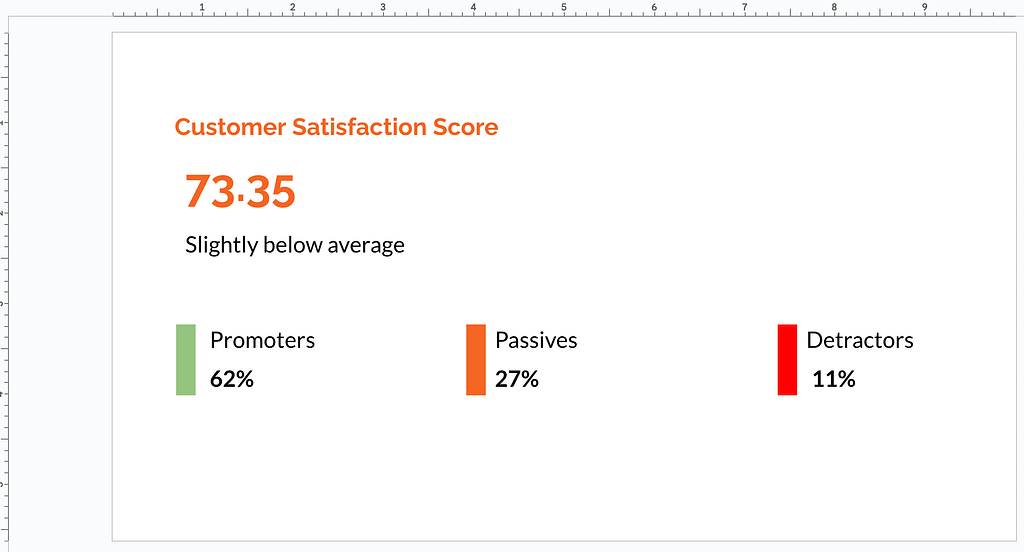
It took time to realize that satisfaction is only the first layer of the story.
Satisfied customers are more likely to return, recommend, and spend more. Dissatisfied ones churn, or create additional support costs.
When we connect dots, the design narrative shifts from abstract satisfaction to measurable performance.
For instance, research from McKinsey & Company analyzing 70 top-selling product categories found that items with 3–4⭐ ratings sold roughly three times more than those with 1⭐ , and even small rating increases: from 4.2⭐ to 4.4⭐, led to meaningful sales gains.
Using that elasticity, if 10% more customers move from rating 3⭐ to 4–5⭐, the repeat purchase rate can rise by about 5%. On $100,000 in monthly revenue, that translates to an estimated +$5,000 per month.
That’s the same design improvement but presented in business terms.
It transforms the conversation from “We improved CSAT by 10 points” to “We expect a 5% increase in monthly revenue from returning buyers.”
Example 2: Internal Tools for restaurant managers
Nowadays at Yum! Brands, my team focuses on internal products used by restaurant staff. There are no direct “sales” metrics to reference, so our approach centers on connecting efficiency improvements to operational outcomes.

Consider a simplified example (illustrative data only!): this is not based on real wages or time measurements. The numbers are entirely hypothetical and used purely to show how the calculation works.
If the average time to complete a digital checklist decreases from let’s say 5 minutes to 3, that’s 2 minutes saved per employee. Across 100 employees earning $30 per hour, this equals roughly $100 per hour saved or about $208,000 per year in potential efficiency gains.
Framed this way, a design decision is no longer just an interface improvement: it becomes a tangible cost optimization. This translation helps stakeholders see design as a strategic contributor rather than a support function.
What We’ve Observed Across Teams
Working with designers from different locations, similar patterns appear. Teams consistently produce strong visuals, conduct usability tests, and document detailed design flows. Yet many stop at reporting that “users liked it” or “completion rates improved.”
What often goes missing is the translation layer between usability metrics and organizational priorities.
A faster checkout isn’t only a better user experience, it means more transactions per hour. Reducing form errors doesn’t just improve usability, it lowers support volume and operational cost.
When design outcomes are expressed through business language, design gains credibility at every level of the organization.
Shifting How We Present Our Work

Our portfolios become much stronger when we move beyond surface-level results and start demonstrating how design impacts key metrics. We don’t need full access to internal financial data to do this: relative improvements, percentage changes, or realistic projections can all tell a powerful story.
In many ways, this shift mirrors a larger transformation in our field. As AI and analytics tools become more accessible, translating design metrics into business metrics has never been easier.
What matters is that we, as designers, begin to think and communicate in terms of value created, not just experiences delivered.

Working Within NDAs Without Losing the Story
One of the most common challenges when building portfolios is confidentiality. Many of us work under NDAs that limit what can be shown publicly. However, NDAs typically restrict specific details but not the ability to share our process or outcomes in abstract form.
When details can’t be shared directly, we can:
- Replace branding or company names.
- Describe challenges and outcomes generically.
- Use relative metrics (e.g., “drop-off decreased by 20%”) instead of exact figures.
- Explain our approach to measurement, what we tracked and why it mattered.
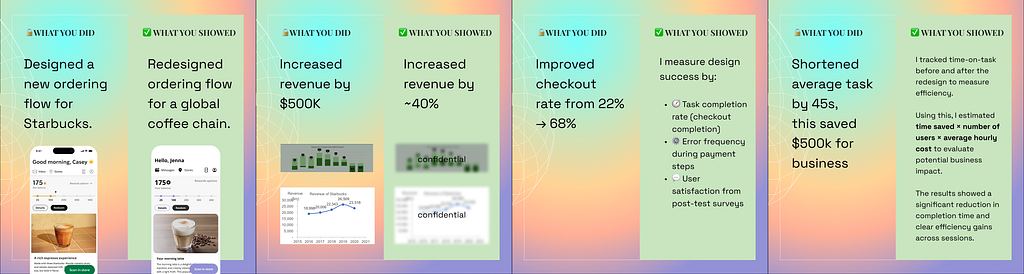
In cases where the NDA is very strict, it’s still possible to discuss how success was measured. That transparency about thought process often communicates just as much impact as the numbers themselves.
Confidentiality doesn’t have to mean silence it simply requires careful framing.
Moving Forward Together
The ability to connect design work to measurable impact is becoming one of the defining skills of modern UX. Even basic metrics, time on task, conversion, satisfaction gain new meaning when they are linked to outcomes that the business values.
In the coming months, I am interested to share more resources, frameworks, and possibly open portfolio review sessions to continue this conversation, especially in Vietnam, where I am located now. Please support and let me know if that is interesting topic for you.
The goal is challenging and simple together: to explore together how to move from showing designs to demonstrating impact.
References & Further Reading
- McKinsey & Company. “Five-star growth: Using online ratings to design better products.” (2023) https://www.mckinsey.com/industries/consumer-packaged-goods/our-insights/five-star-growth-using-online-ratings-to-design-better-products
- CustomerGauge. “The ROI of NPS: Linking Customer Experience to Growth.” https://customergauge.com/blog/nps-impact-on-revenue
- Nielsen Norman Group. “UX Metrics and ROI: How to Measure the Business Impact of Design.” https://www.nngroup.com/reports/ux-metrics-roi/
Why Most UX Portfolios Fail to Impress Stakeholders (and How to Fix It) was originally published in UX Planet on Medium, where people are continuing the conversation by highlighting and responding to this story.
المصدر: المصدر الأصلي
{“@context”:”https://schema.org”,”@type”:”NewsArticle”,”headline”:”Why Most UX Portfolios Fail to Impress Stakeholders (and How to Fix It)”,”description”:”
The Gap Between Design and Business
Over the past three years, acting as UX Manager, I’ve reviewed hundreds of portfolios, from emerging designers to experienced seniors. A pattern consistently emerges:
- Only around 10% of junior to mid-level designers include any metrics in their portfolios.
- Even at senior levels, metrics tend to be design-focused: task completion rates, user satisfaction, or system adoption.
These measures reflect design quality and usability, but they often stop short of showing what stakeholders truly care about: business outcomes.
That gap in language creates a trust barrier between design teams and decision-makers. We often demonstrate how users feel, but not how that translates into performance, efficiency, or growth.
Interestingly, this isn’t just a corporate design challenge. For freelancers, business metrics are often the most persuasive way to communicate value and justify investment.
Understanding Why Metrics Matter
When our teams talk only about usability or delight, we risk optimizing for the interface instead of the organization. Design, at its best, is a business function. It creates measurable outcomes: reduces costs, increases conversions, improves productivity.
If we want design to be viewed as a true business partner, we need to show how our work contributes to growth and efficiency, not just to smoother interactions.
Example 1: Freelance Work in E-Commerce
Earlier in my career as a freelance designer, I often reported “customer satisfaction scores” stats collected through quick pop-up surveys. These looked positive on slides, but clients often asked the same question: “That’s good to know, but what does it mean for us?”
It took time to realize that satisfaction is only the first layer of the story.
Satisfied customers are more likely to return, recommend, and spend more. Dissatisfied ones churn, or create additional support costs.
When we connect dots, the design narrative shifts from abstract satisfaction to measurable performance.
For instance, research from McKinsey & Company analyzing 70 top-selling product categories found that items with 3–4⭐ ratings sold roughly three times more than those with 1⭐ , and even small rating increases: from 4.2⭐ to 4.4⭐, led to meaningful sales gains.
Using that elasticity, if 10% more customers move from rating 3⭐ to 4–5⭐, the repeat purchase rate can rise by about 5%. On $100,000 in monthly revenue, that translates to an estimated +$5,000 per month.
That’s the same design improvement but presented in business terms.
It transforms the conversation from “We improved CSAT by 10 points” to “We expect a 5% increase in monthly revenue from returning buyers.”
Example 2: Internal Tools for restaurant managers
Nowadays at Yum! Brands, my team focuses on internal products used by restaurant staff. There are no direct “sales” metrics to reference, so our approach centers on connecting efficiency improvements to operational outcomes.
Consider a simplified example (illustrative data only!): this is not based on real wages or time measurements. The numbers are entirely hypothetical and used purely to show how the calculation works.
If the average time to complete a digital checklist decreases from let’s say 5 minutes to 3, that’s 2 minutes saved per employee. Across 100 employees earning $30 per hour, this equals roughly $100 per hour saved or about $208,000 per year in potential efficiency gains.
Framed this way, a design decision is no longer just an interface improvement: it becomes a tangible cost optimization. This translation helps stakeholders see design as a strategic contributor rather than a support function.
What We’ve Observed Across Teams
Working with designers from different locations, similar patterns appear. Teams consistently produce strong visuals, conduct usability tests, and document detailed design flows. Yet many stop at reporting that “users liked it” or “completion rates improved.”
What often goes missing is the translation layer between usability metrics and organizational priorities.
A faster checkout isn’t only a better user experience, it means more transactions per hour. Reducing form errors doesn’t just improve usability, it lowers support volume and operational cost.
When design outcomes are expressed through business language, design gains credibility at every level of the organization.
Shifting How We Present Our Work
Our portfolios become much stronger when we move beyond surface-level results and start demonstrating how design impacts key metrics. We don’t need full access to internal financial data to do this: relative improvements, percentage changes, or realistic projections can all tell a powerful story.
In many ways, this shift mirrors a larger transformation in our field. As AI and analytics tools become more accessible, translating design metrics into business metrics has never been easier.
What matters is that we, as designers, begin to think and communicate in terms of value created, not just experiences delivered.
Working Within NDAs Without Losing the Story
One of the most common challenges when building portfolios is confidentiality. Many of us work under NDAs that limit what can be shown publicly. However, NDAs typically restrict specific details but not the ability to share our process or outcomes in abstract form.
When details can’t be shared directly, we can:
- Replace branding or company names.
- Describe challenges and outcomes generically.
- Use relative metrics (e.g., “drop-off decreased by 20%”) instead of exact figures.
- Explain our approach to measurement, what we tracked and why it mattered.
In cases where the NDA is very strict, it’s still possible to discuss how success was measured. That transparency about thought process often communicates just as much impact as the numbers themselves.
Confidentiality doesn’t have to mean silence it simply requires careful framing.
Moving Forward Together
The ability to connect design work to measurable impact is becoming one of the defining skills of modern UX. Even basic metrics, time on task, conversion, satisfaction gain new meaning when they are linked to outcomes that the business values.
In the coming months, I am interested to share more resources, frameworks, and possibly open portfolio review sessions to continue this conversation, especially in Vietnam, where I am located now. Please support and let me know if that is interesting topic for you.
The goal is challenging and simple together: to explore together how to move from showing designs to demonstrating impact.
References & Further Reading
- McKinsey & Company. “Five-star growth: Using online ratings to design better products.” (2023) https://www.mckinsey.com/industries/consumer-packaged-goods/our-insights/five-star-growth-using-online-ratings-to-design-better-products
- CustomerGauge. “The ROI of NPS: Linking Customer Experience to Growth.” https://customergauge.com/blog/nps-impact-on-revenue
- Nielsen Norman Group. “UX Metrics and ROI: How to Measure the Business Impact of Design.” https://www.nngroup.com/reports/ux-metrics-roi/
Why Most UX Portfolios Fail to Impress Stakeholders (and How to Fix It) was originally published in UX Planet on Medium, where people are continuing the conversation by highlighting and responding to this story.
“,”datePublished”:”2025-10-30 15:37:28″,”author”:{“@type”:”Organization”,”name”:”العربية”},”publisher”:{“@type”:”Organization”,”name”:”Newsly”,”url”:”http://wordpress-hr2d6.wasmer.app”},”image”:”https://cdn-images-1.medium.com/max/1024/1*cmKnejKjZqbpg0JxRTIFeg.png”}

Post Comment