The Book Every Designer Should Read in the AI era
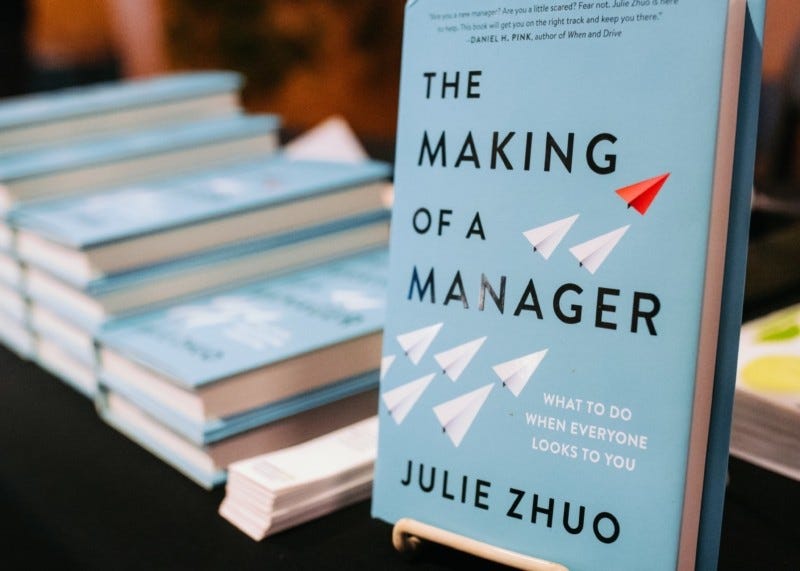
Lessons from Julie Zhuo’s ‘The Making of a Manager’
I picked up The Making of a Manager this December, six years after its release. I expected a dated management primer. What I found instead was a playbook that’s become more relevant, not less, as AI reshapes what it means to lead design teams.
The timing felt accidental but perfect. As we close out 2025 — a year that Zalando’s design community calls full of “AI-fuelled ‘aha’ moments” and “unexpected shifts” — Julie Zhuo’s framework for purpose, people, and process has evolved from helpful guidance to survival strategy.
When Your Job Description Dissolves
Here’s the uncomfortable truth about 2025: the traditional product roles are dying.
For the past two decades, we’ve organized around specialization — product designer, engineer, PM, researcher, data analyst. Clear career ladders. Industry standards for what makes a junior designer versus a principal. Zhuo herself rose through this system, from Facebook intern to VP of Product Design.
But in a recent conversation on Lenny’s Podcast, Zhuo crystallized what many designers are feeling but haven’t named: “Let’s not think of ourselves as these predefined roles. Let’s just actually think of ourselves as builders.”
This isn’t philosophical musing. It’s math. If AI enables one or two people to do what previously took six, we don’t need six distinct roles anymore. As Zhuo puts it, “every six months, we see new models that are smarter and more capable.”
For designers reading The Making of a Manager today, the question isn’t “how do I manage designers?” It’s “how do I help people create impact when their job titles might not exist in three years?”
What Actually Transfers When Everything Changes
Here’s where Zhuo’s book transcends its original intent. The core insight — that management is about enabling others to achieve better outcomes together than they could alone — remains constant even as the tools and roles transform.
She breaks this down into three areas: purpose, people, and process.
Purpose used to mean aligning your team around clear objectives. In 2025, purpose means helping people understand why their work matters when AI can generate passable designs in seconds. It’s no longer “we’re redesigning the checkout flow.” It’s “we’re the humans who know whether this AI-generated flow will actually reduce cart abandonment for our specific users in ways that preserve trust and brand integrity.”
According to a September 2025 trends analysis, designers now bring “deeper research expertise and business thinking to the table.” The craft execution has been democratized. What hasn’t been democratized is judgment.
People management becomes even more critical when roles blur. Zhuo emphasizes understanding each person’s unique strengths — not just their design skills. In 2025, this means recognizing who has exceptional product taste (the ability to know when AI output is good enough versus great), who excels at stakeholder translation, who understands the technical constraints that AI can’t yet grasp.
Your job isn’t to be the best designer anymore. It’s to build an environment where people can develop the skills AI can’t replicate: nuanced judgment, contextual understanding, emotional intelligence about user needs.
Process determines whether your team wastes time in meetings or ships impactful work. With AI handling routine design tasks, thoughtful process design separates high-performing teams from those drowning in collaboration theater. As Figma’s State of the Designer 2025 report notes, while 77% of happy designers use collaborative tools frequently, 91% of developers still think the handoff process needs improvement.
Feedback in the Age of AI Output
Zhuo’s feedback framework becomes more valuable, not less, when AI enters the workflow.
Her rule: make feedback concrete, clarify what success looks like, suggest next steps. “This needs more impact” remains useless. Better: “The hierarchy isn’t clear here. Success looks like users immediately understanding the primary action. The AI got the layout right, but the contrast between the CTA and secondary actions needs adjustment. Try these specific values, and let’s review tomorrow.”
She also destroys the “compliment sandwich” — that tired technique of hiding criticism between compliments. It comes across as insincere and confuses the message. When AI can generate variations instantly, clear feedback becomes the bottleneck to great work.
The critical new skill: giving feedback on whether to use AI output at all. When is the AI-generated solution good enough? When does it need human refinement? When should you start from scratch? This judgment — what Zhuo calls “product taste” — is what separates great builders from average ones in 2025.
The Meeting Crisis Gets Worse Before It Gets Better
“Meetings take a lot of time and energy, which are precious and finite,” Zhuo writes. “This is why you should guard them like a dragon guards its treasure stash.”
In 2025, this warning hits different. AI hasn’t eliminated meetings — it’s created new ones. Now we have standups, critiques, stakeholder reviews, planning sessions, retrospectives, and sessions to review AI outputs, discuss tool choices, and debate which tasks to automate.
Zhuo’s filter remains ruthless: every meeting should accomplish exactly one goal — decision making, information sharing, idea generation, or norm setting. If a meeting tries to do multiple things, it probably does none well.
For design critiques, be explicit: Are we generating ideas (diverge)? Making decisions (converge)? Aligning on direction? The worst critiques try to do all three.
She also points out that brainstorming meetings are often overrated. Research shows people generate better ideas alone than in groups. A better approach in the AI era: have people ideate with AI tools individually first, then come together to combine and evolve the best concepts. Let AI handle divergence; reserve human time for convergence.
Growth Over Perfection: The Only Sustainable Advantage
In a world where AI can execute at an average-to-good level consistently, growth becomes the sustainable competitive advantage.
Zhuo references Carol Dweck’s research on fixed versus growth mindsets. Design culture often fetishizes the “genius designer” — the person with innate taste who just “gets it.” This creates an environment where designers fear showing works in progress or admitting they’re struggling.
In 2025, this mindset is actively harmful. When AI lowers the barrier to basic execution, the question becomes: what are you learning that AI can’t replicate? How are you developing judgment? How are you improving at the meta-skill of directing AI effectively?
Zhuo advocates celebrating growth explicitly. When someone improves their ability to evaluate AI outputs, or learns to communicate design decisions more effectively to non-designers, name it. Make it clear that progression is valued as much as current ability.
The Identity Crisis Every Designer Faces
The book’s most powerful message isn’t about management techniques — it’s about identity.
When you become a manager, Zhuo argues, you’re not a designer who occasionally manages. You’re a manager whose job happens to be design. That distinction changes everything.
In 2025, there’s a parallel identity crisis: as AI handles more execution, are you still a designer? Or are you something else — a builder, as Zhuo suggests? A taste-maker? A judgment-provider?
The answer matters less than accepting the shift. Those who cling to “I’m a designer, and designers make things in Figma” will struggle. Those who embrace “I’m a builder who uses design thinking, Figma, AI, and whatever else solves the problem” will thrive.
What This Means for Design Leaders Right Now
As we close 2025 and look toward 2026, several industry trends amplify Zhuo’s lessons:
The rise of hyper-personalization means design leaders must help teams understand not just what to build, but for whom specifically. AI can generate variations; humans must decide which variations matter.
Sustainability and accessibility are now baseline expectations, not differentiators. European accessibility laws now penalize non-compliance. Design leaders must build cultures where these aren’t checkboxes but embedded values.
Social commerce is exploding across Instagram, TikTok, Pinterest, and YouTube. The fusion of commerce and social media requires design leaders who can orchestrate across platforms, not just optimize single experiences.
The “death of product development” — Zhuo’s recent essay topic — means traditional pod structures (designer, PM, engineer, researcher) are dissolving. Leaders must figure out how to organize when everyone is a “builder” with overlapping capabilities.
The Questions That Actually Matter
I finished The Making of a Manager this week with a different question than Zhuo probably intended when she wrote it in 2019.
She asked: how do you enable a group of people to achieve better outcomes together than they could alone?
In late 2025, I’m asking: how do you enable a group of people plus AI agents to achieve better outcomes than either could alone?
The principles transfer. Clear purpose. Understanding individuals’ strengths. Thoughtful process. Concrete feedback. Celebrating growth. These matter even more when the tools change every six months.
But there’s a meta-lesson Zhuo probably didn’t anticipate: the best managers in 2025 aren’t just managing people. They’re managing the relationship between people and rapidly evolving technology. They’re helping teams navigate uncertainty about their roles. They’re maintaining culture when job definitions dissolve.
If AI can handle mechanical aspects of design, what’s left? Zhuo’s answer, updated for our moment: helping a group of humans understand which problems to solve, evaluate whether AI’s solutions are actually good, and maintain judgment when it’s easier to accept the first passable output.
That’s not a job AI can do. At least not yet.
And that’s exactly why a book about managing people remains essential reading in an age of managing alongside machines.
References
- Zhuo, J. (2019). The Making of a Manager: What to Do When Everyone Looks to You. Portfolio/Penguin.
- Lenny’s Podcast (September 2025). “From managing people to managing AI: How the same leadership skills apply in the age of AI | Julie Zhuo.” https://www.lennysnewsletter.com/p/from-managing-people-to-managing-ai-julie-zhuo
- Zalando Design (July 2025). “2025’s biggest surprises in product design so far.” https://medium.com/zalando-design/2025s-biggest-surprises-in-product-design-so-far-1c14434afa3b
- Transcenda (2025). “Product Design Trends 2025.” https://www.transcenda.com/insights/game-changing-product-design-whats-hot-in-2025
- Figma (2025). “State of the Designer 2025.”
- Design Rush (December 2025). “Top 7 Product Design Trends Shaping 2025.” https://www.designrush.com/agency/product-design/trends/product-design-trends
- Career Foundry (June 2025). “The Top 12 Product Design Trends for 2025.” https://careerfoundry.com/en/blog/product-design/product-design-trends/
The Book Every Designer Should Read in the AI era was originally published in UX Planet on Medium, where people are continuing the conversation by highlighting and responding to this story.
المصدر: المصدر الأصلي
{“@context”:”https://schema.org”,”@type”:”NewsArticle”,”headline”:”The Book Every Designer Should Read in the AI era”,”description”:”
Lessons from Julie Zhuo’s ‘The Making of a Manager’
I picked up The Making of a Manager this December, six years after its release. I expected a dated management primer. What I found instead was a playbook that’s become more relevant, not less, as AI reshapes what it means to lead design teams.
The timing felt accidental but perfect. As we close out 2025 — a year that Zalando’s design community calls full of “AI-fuelled ‘aha’ moments” and “unexpected shifts” — Julie Zhuo’s framework for purpose, people, and process has evolved from helpful guidance to survival strategy.
When Your Job Description Dissolves
Here’s the uncomfortable truth about 2025: the traditional product roles are dying.
For the past two decades, we’ve organized around specialization — product designer, engineer, PM, researcher, data analyst. Clear career ladders. Industry standards for what makes a junior designer versus a principal. Zhuo herself rose through this system, from Facebook intern to VP of Product Design.
But in a recent conversation on Lenny’s Podcast, Zhuo crystallized what many designers are feeling but haven’t named: “Let’s not think of ourselves as these predefined roles. Let’s just actually think of ourselves as builders.”
This isn’t philosophical musing. It’s math. If AI enables one or two people to do what previously took six, we don’t need six distinct roles anymore. As Zhuo puts it, “every six months, we see new models that are smarter and more capable.”
For designers reading The Making of a Manager today, the question isn’t “how do I manage designers?” It’s “how do I help people create impact when their job titles might not exist in three years?”
What Actually Transfers When Everything Changes
Here’s where Zhuo’s book transcends its original intent. The core insight — that management is about enabling others to achieve better outcomes together than they could alone — remains constant even as the tools and roles transform.
She breaks this down into three areas: purpose, people, and process.
Purpose used to mean aligning your team around clear objectives. In 2025, purpose means helping people understand why their work matters when AI can generate passable designs in seconds. It’s no longer “we’re redesigning the checkout flow.” It’s “we’re the humans who know whether this AI-generated flow will actually reduce cart abandonment for our specific users in ways that preserve trust and brand integrity.”
According to a September 2025 trends analysis, designers now bring “deeper research expertise and business thinking to the table.” The craft execution has been democratized. What hasn’t been democratized is judgment.
People management becomes even more critical when roles blur. Zhuo emphasizes understanding each person’s unique strengths — not just their design skills. In 2025, this means recognizing who has exceptional product taste (the ability to know when AI output is good enough versus great), who excels at stakeholder translation, who understands the technical constraints that AI can’t yet grasp.
Your job isn’t to be the best designer anymore. It’s to build an environment where people can develop the skills AI can’t replicate: nuanced judgment, contextual understanding, emotional intelligence about user needs.
Process determines whether your team wastes time in meetings or ships impactful work. With AI handling routine design tasks, thoughtful process design separates high-performing teams from those drowning in collaboration theater. As Figma’s State of the Designer 2025 report notes, while 77% of happy designers use collaborative tools frequently, 91% of developers still think the handoff process needs improvement.
Feedback in the Age of AI Output
Zhuo’s feedback framework becomes more valuable, not less, when AI enters the workflow.
Her rule: make feedback concrete, clarify what success looks like, suggest next steps. “This needs more impact” remains useless. Better: “The hierarchy isn’t clear here. Success looks like users immediately understanding the primary action. The AI got the layout right, but the contrast between the CTA and secondary actions needs adjustment. Try these specific values, and let’s review tomorrow.”
She also destroys the “compliment sandwich” — that tired technique of hiding criticism between compliments. It comes across as insincere and confuses the message. When AI can generate variations instantly, clear feedback becomes the bottleneck to great work.
The critical new skill: giving feedback on whether to use AI output at all. When is the AI-generated solution good enough? When does it need human refinement? When should you start from scratch? This judgment — what Zhuo calls “product taste” — is what separates great builders from average ones in 2025.
The Meeting Crisis Gets Worse Before It Gets Better
“Meetings take a lot of time and energy, which are precious and finite,” Zhuo writes. “This is why you should guard them like a dragon guards its treasure stash.”
In 2025, this warning hits different. AI hasn’t eliminated meetings — it’s created new ones. Now we have standups, critiques, stakeholder reviews, planning sessions, retrospectives, and sessions to review AI outputs, discuss tool choices, and debate which tasks to automate.
Zhuo’s filter remains ruthless: every meeting should accomplish exactly one goal — decision making, information sharing, idea generation, or norm setting. If a meeting tries to do multiple things, it probably does none well.
For design critiques, be explicit: Are we generating ideas (diverge)? Making decisions (converge)? Aligning on direction? The worst critiques try to do all three.
She also points out that brainstorming meetings are often overrated. Research shows people generate better ideas alone than in groups. A better approach in the AI era: have people ideate with AI tools individually first, then come together to combine and evolve the best concepts. Let AI handle divergence; reserve human time for convergence.
Growth Over Perfection: The Only Sustainable Advantage
In a world where AI can execute at an average-to-good level consistently, growth becomes the sustainable competitive advantage.
Zhuo references Carol Dweck’s research on fixed versus growth mindsets. Design culture often fetishizes the “genius designer” — the person with innate taste who just “gets it.” This creates an environment where designers fear showing works in progress or admitting they’re struggling.
In 2025, this mindset is actively harmful. When AI lowers the barrier to basic execution, the question becomes: what are you learning that AI can’t replicate? How are you developing judgment? How are you improving at the meta-skill of directing AI effectively?
Zhuo advocates celebrating growth explicitly. When someone improves their ability to evaluate AI outputs, or learns to communicate design decisions more effectively to non-designers, name it. Make it clear that progression is valued as much as current ability.
The Identity Crisis Every Designer Faces
The book’s most powerful message isn’t about management techniques — it’s about identity.
When you become a manager, Zhuo argues, you’re not a designer who occasionally manages. You’re a manager whose job happens to be design. That distinction changes everything.
In 2025, there’s a parallel identity crisis: as AI handles more execution, are you still a designer? Or are you something else — a builder, as Zhuo suggests? A taste-maker? A judgment-provider?
The answer matters less than accepting the shift. Those who cling to “I’m a designer, and designers make things in Figma” will struggle. Those who embrace “I’m a builder who uses design thinking, Figma, AI, and whatever else solves the problem” will thrive.
What This Means for Design Leaders Right Now
As we close 2025 and look toward 2026, several industry trends amplify Zhuo’s lessons:
The rise of hyper-personalization means design leaders must help teams understand not just what to build, but for whom specifically. AI can generate variations; humans must decide which variations matter.
Sustainability and accessibility are now baseline expectations, not differentiators. European accessibility laws now penalize non-compliance. Design leaders must build cultures where these aren’t checkboxes but embedded values.
Social commerce is exploding across Instagram, TikTok, Pinterest, and YouTube. The fusion of commerce and social media requires design leaders who can orchestrate across platforms, not just optimize single experiences.
The “death of product development” — Zhuo’s recent essay topic — means traditional pod structures (designer, PM, engineer, researcher) are dissolving. Leaders must figure out how to organize when everyone is a “builder” with overlapping capabilities.
The Questions That Actually Matter
I finished The Making of a Manager this week with a different question than Zhuo probably intended when she wrote it in 2019.
She asked: how do you enable a group of people to achieve better outcomes together than they could alone?
In late 2025, I’m asking: how do you enable a group of people plus AI agents to achieve better outcomes than either could alone?
The principles transfer. Clear purpose. Understanding individuals’ strengths. Thoughtful process. Concrete feedback. Celebrating growth. These matter even more when the tools change every six months.
But there’s a meta-lesson Zhuo probably didn’t anticipate: the best managers in 2025 aren’t just managing people. They’re managing the relationship between people and rapidly evolving technology. They’re helping teams navigate uncertainty about their roles. They’re maintaining culture when job definitions dissolve.
If AI can handle mechanical aspects of design, what’s left? Zhuo’s answer, updated for our moment: helping a group of humans understand which problems to solve, evaluate whether AI’s solutions are actually good, and maintain judgment when it’s easier to accept the first passable output.
That’s not a job AI can do. At least not yet.
And that’s exactly why a book about managing people remains essential reading in an age of managing alongside machines.
References
- Zhuo, J. (2019). The Making of a Manager: What to Do When Everyone Looks to You. Portfolio/Penguin.
- Lenny’s Podcast (September 2025). “From managing people to managing AI: How the same leadership skills apply in the age of AI | Julie Zhuo.” https://www.lennysnewsletter.com/p/from-managing-people-to-managing-ai-julie-zhuo
- Zalando Design (July 2025). “2025’s biggest surprises in product design so far.” https://medium.com/zalando-design/2025s-biggest-surprises-in-product-design-so-far-1c14434afa3b
- Transcenda (2025). “Product Design Trends 2025.” https://www.transcenda.com/insights/game-changing-product-design-whats-hot-in-2025
- Figma (2025). “State of the Designer 2025.”
- Design Rush (December 2025). “Top 7 Product Design Trends Shaping 2025.” https://www.designrush.com/agency/product-design/trends/product-design-trends
- Career Foundry (June 2025). “The Top 12 Product Design Trends for 2025.” https://careerfoundry.com/en/blog/product-design/product-design-trends/
The Book Every Designer Should Read in the AI era was originally published in UX Planet on Medium, where people are continuing the conversation by highlighting and responding to this story.
“,”datePublished”:”2025-12-16 11:31:13″,”author”:{“@type”:”Organization”,”name”:”العربية”},”publisher”:{“@type”:”Organization”,”name”:”Newsly”,”url”:”http://wordpress-hr2d6.wasmer.app”},”image”:”https://cdn-images-1.medium.com/max/800/0*b_g9fCCrhiR4ncoi”}

Post Comment